Rhythm Without Boundaries
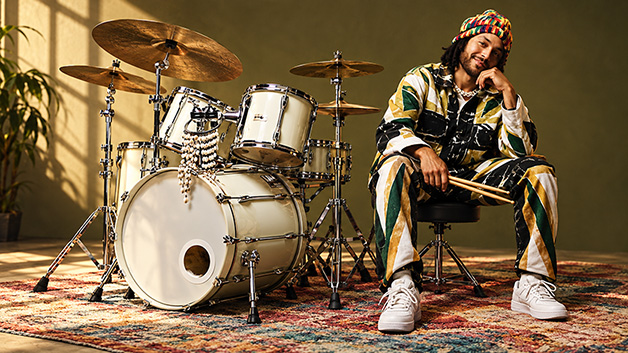
Yussef Dayes is a British drummer, composer, and producer whose music brings jazz into conversation with funk, soul, hip-hop, and electronic rhythms. Raised in South London, he has developed a style that combines technical precision with a strong sense of movement and emotion. His work places the drums at the center of the musical story, showing how rhythm can shape a composition as powerfully as a voice, piano, or saxophone.
Dayes’s musical education began at home, where experimentation was encouraged and music became a shared family language. He started drumming at about four years old and grew up alongside three brothers. By age ten, he had the opportunity to study with celebrated jazz-fusion drummer Billy Cobham. His early influences extended from African and Caribbean rhythms to the grime and jungle sounds circulating around London, giving him a broad foundation for his own approach.
One of his early creative homes was United Vibrations, a group that included his brothers Ahmad and Kareem and saxophonist Wayne Francis. The ensemble brought together Afrobeat, jazz, and rock, giving Dayes room to develop within a collaborative setting. Playing alongside family also established a pattern that would continue throughout his career: music built through close relationships, shared listening, and the freedom to respond to one another in the moment.
Dayes reached a wider audience through Yussef Kamaal, his partnership with keyboardist Kamaal Williams. Their 2016 album, Black Focus, became an important recording in the emergence of London’s contemporary jazz movement. Its blend of improvisation, keyboard textures, and propulsive rhythms connected jazz musicianship with the energy of club culture. Although the partnership was brief, the album helped establish Dayes as a distinctive drummer whose playing could appeal across musical boundaries.
Another significant collaboration arrived in 2020 with What Kinda Music, the album Dayes made with guitarist and singer Tom Misch. Released through Blue Note, the project combined Misch’s melodic sensibility with Dayes’s restless rhythmic imagination. Jazz, electronic production, and hip-hop all found space within the recording. The partnership introduced Dayes to additional listeners while demonstrating how effectively his drumming could interact with vocals and tightly structured songs.
In September 2023, Dayes released his debut solo studio album, Black Classical Music. Across 19 tracks, he presented a broader picture of himself as a composer and bandleader. Bassist Rocco Palladino, keyboardist Charlie Stacey, saxophonist Venna, and percussionist Alexander Bourt helped anchor the music. Guests including Chronixx, Masego, Jamilah Barry, Shabaka Hutchings, and the Chineke! Orchestra expanded its range without diminishing the rhythmic identity at its center.
The album’s title expresses Dayes’s understanding of musical heritage. Rather than treating jazz as an isolated category, he connects it to a wider tradition of Black creativity, improvisation, and rhythmic knowledge. In his discussion of the record, he described musical genres as restrictive and emphasized following rhythm across those boundaries. The result is an artistic approach that values the relationships among sounds as much as the labels attached to them.
Family, grief, and fatherhood also give Black Classical Music its emotional foundation. Dayes has explained that becoming a father in 2020 encouraged him to reflect on the influence of his parents. His mother, who died in 2015, remained a guiding presence in his thinking about the album. These personal connections help explain why the project reaches beyond instrumental display: it is also concerned with remembrance, healing, love, and the experiences that give music meaning.
Live performance is another essential part of Dayes’s identity. Projects such as Live at Joshua Tree and Live From Malibu foreground the interaction between musicians, allowing listeners to watch ideas develop through timing, attention, and improvisation. His performances have also reached major stages, including a sold-out Royal Albert Hall. That emphasis on the live encounter reinforces the physical character of his music—the exchange between a drummer, an ensemble, and an audience.
Dayes’s reach extends beyond his own recordings through work with artists including Sampha, Noname, Wizkid, Kali Uchis, and Kehlani. These collaborations show how naturally his musical vocabulary moves between contemporary jazz, soul, and popular music. Across those settings, his central contribution remains consistent: a rhythmic voice that supports other musicians while retaining its own character. His career offers a compelling example of how a drummer can serve simultaneously as accompanist, composer, collaborator, and creative leader.