Wynton Marsalis And The Meaning Of Liberty
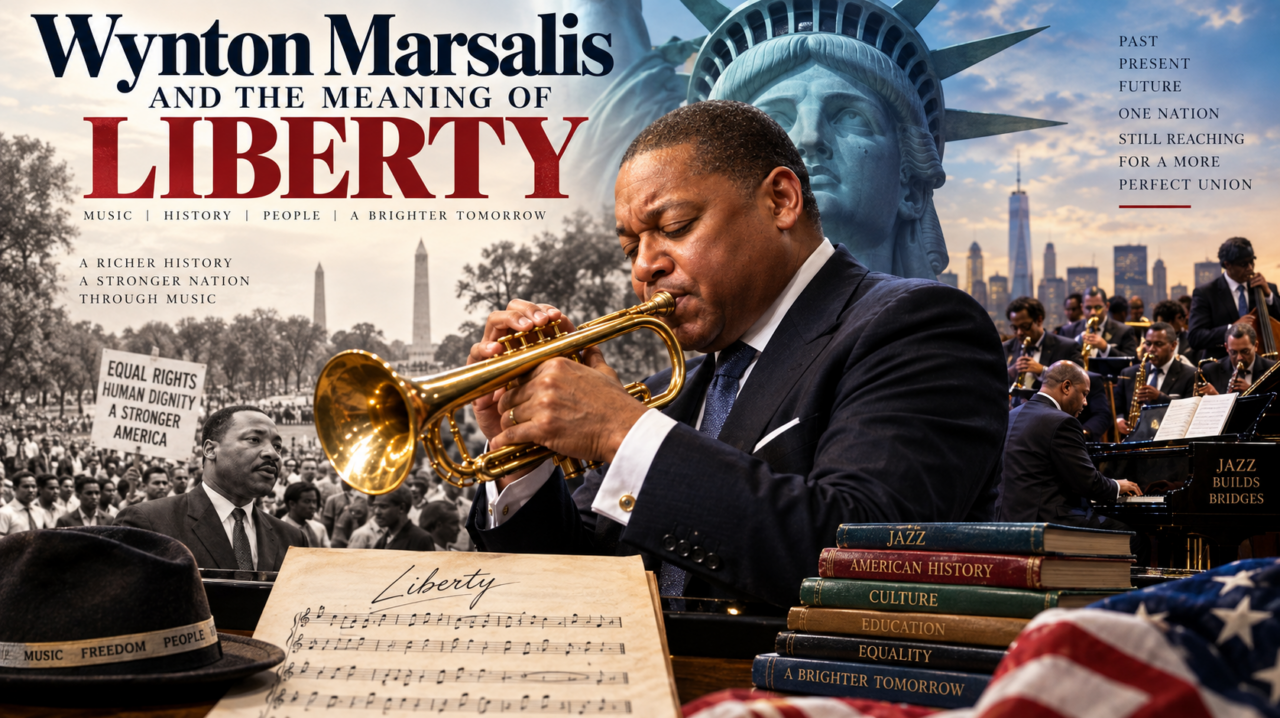
Wynton Marsalis’s Liberty is an ambitious musical work that explores one of America’s most complicated and enduring ideas: freedom. Rather than treating liberty as a simple concept, Marsalis examines it through the language of jazz, classical music, African American history, and the American experience. The work reflects his belief that music can tell stories about who we are, where we have come from, and what kind of society we hope to become.
Marsalis has spent his career moving comfortably between jazz and the classical tradition. His work often challenges the idea that these musical worlds must remain separate. Liberty continues that tradition by bringing together sophisticated orchestration, rhythmic energy, and the improvisational spirit associated with jazz. The result is music that feels both carefully constructed and emotionally alive.
At the center of the work is the idea of freedom. For African Americans, the word carries an especially deep historical meaning. Freedom is connected to slavery, emancipation, the Civil War, Reconstruction, the civil rights movement, and the continuing struggle for equality. Marsalis understands that American liberty has often been promised before it has been fully delivered. His music allows those contradictions to exist side by side.
One of the most compelling aspects of Liberty is the way Marsalis uses musical contrast. There are moments of grandeur and celebration, but there are also passages that can feel tense, reflective, or unsettled. Those changes are important because the American story itself is filled with contradictions. The country has celebrated democracy while denying basic rights to millions of people. Marsalis uses music to acknowledge both the promise and the problems contained within the American ideal.
Jazz is particularly powerful in this context because improvisation is fundamentally connected to individual expression. A jazz musician has a framework, but within that framework there is room to make something personal and unexpected. Marsalis has long understood that relationship between structure and freedom. In Liberty, that musical principle becomes almost philosophical: true freedom does not necessarily mean having no rules; it can mean having the opportunity to express yourself fully within a shared community.
Marsalis also draws upon the larger American musical tradition. His compositions demonstrate an understanding of European classical forms while remaining deeply connected to African American musical history. That combination is significant because American music itself was created through cultural exchange. Spirituals, blues, jazz, gospel, ragtime, and other traditions helped shape the country’s musical identity. Marsalis recognizes that history while presenting it through his own contemporary voice.
There is also an important sense of responsibility in Marsalis’s approach. He does not treat music simply as entertainment. Throughout his career, he has argued for the educational and cultural importance of jazz and for a deeper understanding of its history. Liberty reflects that philosophy. It asks listeners to engage with the music intellectually as well as emotionally and to consider what the idea of freedom has meant across different generations.
For older listeners who have lived through major periods of American history, a work like Liberty can carry an especially powerful meaning. Someone who remembers the civil rights era, the struggles of the 1960s, and the continuing debates over equality may hear something different from a younger listener. The music can become a kind of historical mirror, connecting the past with the present without reducing the story to a single political message.
Ultimately, Liberty demonstrates Marsalis’s remarkable ability to use music as a form of storytelling. He understands that history does not always need to be explained through words. A change in rhythm, a powerful brass passage, a quiet musical reflection, or the tension between different sections of an orchestra can communicate feelings that ordinary language sometimes cannot capture.
Wynton Marsalis’s Liberty is therefore more than a musical composition about an American ideal. It is an invitation to think about what freedom means, who has experienced it, who has been denied it, and how much work remains to make the promise of liberty real. By bringing jazz and classical music together, Marsalis creates a work that speaks to America’s history while also challenging listeners to consider its future. In that sense, Liberty is not simply about looking backward. It is about asking what kind of freedom we want to carry forward.