A Masterpiece Returns to125th Street
By Fern Gillespie
As the Studio Museum in Harlem reopens, former Director Kinshasha Holman Conwill revisits the vision, artists, and cultural leadership that made the museum a global force.
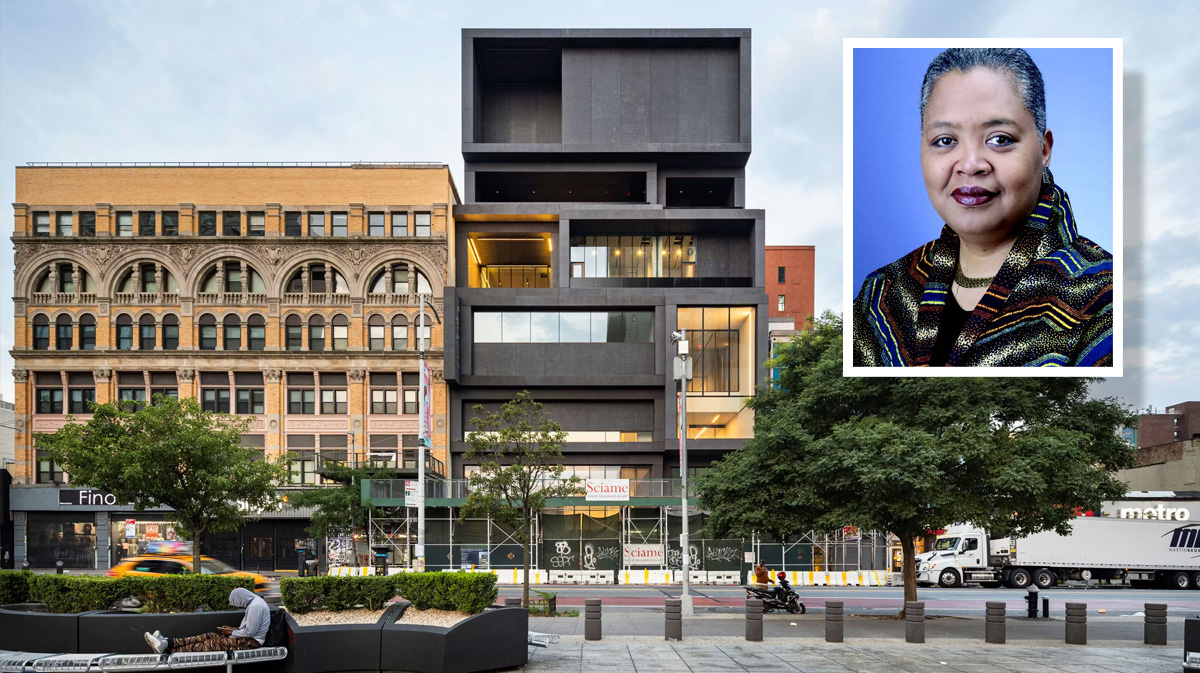
Black art in the heart of Harlem is back. After closing its doors in 2018, the Studio Museum in Harlem has returned as a masterpiece on 125th Street. Light years from its first location in 1968—a loft on Fifth Avenue in Harlem—the new $160 million building, designed by Adjaye Associates, spans 82,000 feet. It now houses a seven-story museum with expansive gallery spaces, a café, a one-story stoop, a teen studio, a reading room, and a rooftop garden.
Black Artists’ Visions and Dreams
Community outreach encompasses creative, familycentered exhibitions and programs to inspire youthful artists. These include: artist Christopher Myers’ exhibition Harlem Is a Myth; Storytime, a storytelling series of books for Black children; drop-in art making classes; and the Teen Studio for young artists.
Boasting a collection of almost 9,000 works of art by Black artists of the African Diaspora, the collection covers over 200 years ranging from the 1800s to the present. This includes owning a Jean-Michel Basquiat—a rarity for a museum.
“The Museum’s reopening is an embodiment of the visions, dreams, and aspirations of the pioneering individuals who inaugurated this institution in 1968,” said Chief of Staff Terrence Phearse. “They understood the significance of having a museum that simultaneously served as a space dedicated to artists of African descent and a site where Harlem residents could take part in educational programs and community events.”
A Director’s Perspective
Kinshasha Holman Conwill, named deputy director under Mary Schmidt Campbell in 1980, became director and served in that capacity from 1988 through 1999. In 2005, Conwill was appointed the Smithsonian’s first deputy director of the National Museum of African American History and Culture (NMAAHC).
“The newly-renovated museum is a testament to the decades-long dedication of its leaders throughout the years, pioneering museum directors such as Charles Inniss, Ed Spriggs, and Mary Schmidt Campbell. They seeded the ground for the institution that now graces the museum’s newly-renovated home on 125th Street,” Conwill said.
Conwill points out that the museum’s landmark Artist in Residence program “brought to the fore and helped launch the careers” of major artists. When Conwill headed the museum, few museums from the Met to the Whitney exhibited solo shows by Black artists. “One of the Studio Museum’s greatest gifts as an institution has been to herald the work of living Black artists. In exhibitions as in the early 1980s, there were one-person shows on Faith Ringgold and Howardena Pindell, curated by Terrie Rouse, the museum’s then senior curator,” and on the work of Sam Gilliam curated by then director Mary Schmidt Campbell,” she explained.
Legendary Black artists were part of the original founders of the Studio Museum. “The foresight of the museum’s curatorial leadership was forged in the crucial days of the 1980s. It was built on the foundational work of its first artist leaders,” she explained. “Artists including Romare Bearden, Elizabeth Catlett, Richard Hunt, Jacob Lawrence, Betye Saar, and Jack Whitten emerged over decades to be among America’s artists who changed the course of American art history, influencing generations of younger artists.”
The Studio Museum’s new building showcases an art installation special to Conwill, Joyful Mysteries, a series of sculptures created by her late husband, renowned artist Houston Conwill.
Preserving Black Art
Kinshasha holds degrees from Mount Holyoke College, a Howard University BFA, and a UCLA MBA. A student of Harlem Renaissance artist Lois Mailou Jones, at Howard, for over 45 years, she has been a leader in preserving Black art and culture as a curator, historian, and author. “It has been the honor of a lifetime to be both director and deputy director of The Studio Museum in Harlem and founding deputy director of the Smithsonian’s NMAAHC,” she said. “Those experiences have book-ended my commitment to the art of the African Diaspora and the determination that the art will continue to be a resource for audiences nationally and worldwide.”