Rainbow Coalition and Enduring Hope
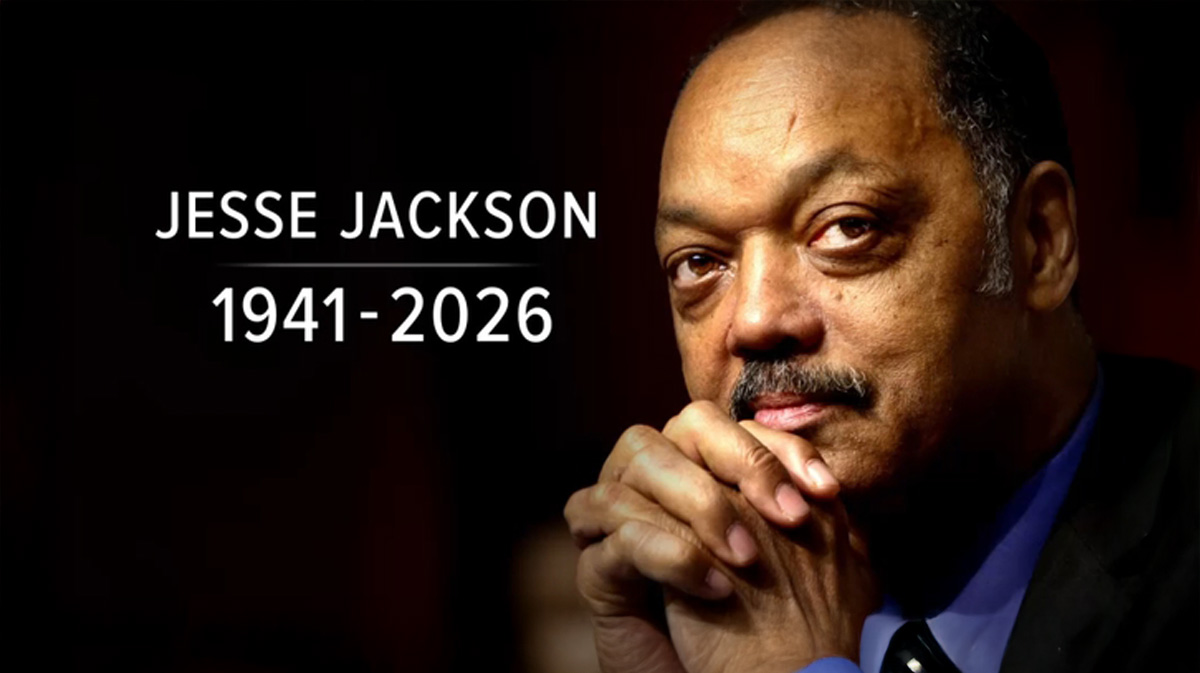
The Rev. Jesse Jackson, the veteran civil rights leader, presidential candidate and founder of the Rainbow PUSH Coalition, died at the age of 84 at his home in Chicago. His family confirmed that he died peacefully, closing the chapter on one of the most consequential public lives in modern American political history. For decades, Jackson stood at the center of debates about race, poverty and power in the United States.
In his later years, Jackson faced significant health struggles. He had announced in 2017 that he had been diagnosed with Parkinson’s disease, and he was later hospitalized with progressive supranuclear palsy, a rare and severe neurodegenerative disorder. Despite these challenges, he continued to appear at rallies, marches and public events, determined to remain active in causes he had championed for more than half a century.
Jackson rose to national prominence in the turbulent years following the assassination of Martin Luther King Jr. in 1968. In the long stretch between King’s death and the election of Barack Obama in 2008, Jackson became the country’s most visible Black political figure. He never achieved King’s near-saintly moral status nor Obama’s electoral breakthrough, but he filled a critical space between those eras.
At the heart of Jackson’s public life was his vision of a “rainbow coalition,” a multiracial alliance of poor and working-class Americans. He believed that people marginalized by race, class and circumstance could unite to demand economic justice and political representation. This populist vision sought to redefine the Democratic Party around the needs of the “disinherited” rather than the traditional white middle class.
Jackson’s gift for oratory made him a dominant presence at Democratic National Conventions in 1984 and 1988. His speeches, delivered in the cadences of the Black church, combined moral urgency with political ambition. The refrain “Keep hope alive” became a rallying cry not just for his campaigns but for a broader progressive movement seeking inclusion and reform.
Born Jesse Louis Burns in 1941 in segregated Greenville, South Carolina, Jackson’s early life was marked by hardship and social stigma. His teenage mother raised him amid the rigid racial hierarchies of the Jim Crow South, and his complicated relationship with his biological and stepfathers left lasting emotional scars. These formative experiences shaped his lifelong sensitivity to rejection and inequality.
Even as a child, Jackson displayed unusual confidence, intelligence and drive. Teachers and classmates noted his boldness and verbal agility, traits that would later define his public persona. He learned early how to navigate humiliation and exclusion, transforming those experiences into ambition rather than defeat.
After high school, Jackson attended the University of Illinois on a football scholarship, an opportunity that exposed him to life outside the segregated South. Yet he encountered racism there as well, discovering that prejudice was not confined to Dixie. He later transferred to North Carolina A&T, a historically Black college where he found community, leadership opportunities and political awakening.
At North Carolina A&T, Jackson became deeply involved in the burgeoning civil rights movement. Inspired by the Greensboro sit-ins, he eventually joined protests and was arrested, drafting his own “Letter From a Greensboro Jail” in homage to King’s famous Birmingham letter. Around this time, he married Jacqueline Brown, with whom he would have five children.
Choosing the ministry over law, Jackson enrolled at Chicago Theological Seminary but soon found himself drawn more to activism than academic study. The violence against demonstrators in Selma in 1965 galvanized him, and he traveled south to join King’s Southern Christian Leadership Conference. There, he impressed some with his energy while irritating others with his ambition.
At just 24 years old, Jackson became the youngest staff member of the SCLC. He was appointed to lead Operation Breadbasket in Chicago, an initiative designed to pressure corporations to hire Black workers and support Black businesses. His success in negotiating with companies brought him national recognition and established him as a rising force in the movement.
King served as both mentor and model for Jackson, who clearly aspired to carry forward his legacy. Yet tensions simmered within the SCLC, as Jackson’s charisma and appetite for media attention sometimes clashed with other leaders. These frictions intensified in the tragic days surrounding King’s assassination in Memphis in 1968.
Jackson’s account of his presence at the Lorraine Motel, and his public display of King’s bloodstained sweater, sparked controversy. Some colleagues accused him of exaggerating his role in King’s final moments to elevate his own profile. The episode damaged relationships within the movement and fueled criticism that would follow him for decades.
After King’s death, Jackson’s disputes with SCLC leadership deepened, leading to his suspension and eventual departure. Free from the organization’s hierarchy, he charted his own path as a national activist. He traveled extensively, advocated for international human rights causes and became a familiar face in American political life.
By the early 1980s, Jackson shifted his focus decisively toward electoral politics. In 1984, he launched a campaign for the Democratic presidential nomination, becoming the first Black candidate to mount a serious bid for a major party’s top ticket since Shirley Chisholm. His campaign mobilized millions of new voters, particularly in the South.
The 1984 campaign showcased both Jackson’s promise and his vulnerabilities. A controversy over antisemitic remarks and his association with controversial figures damaged his standing. Nevertheless, he won more than three million primary votes and delivered a convention speech widely regarded as the emotional high point of the Democratic gathering.
In 1988, Jackson ran again, this time as a major contender. He performed strongly in Super Tuesday contests and ultimately secured nearly seven million votes. Though he fell short of the nomination, his campaign demonstrated that a Black candidate could compete at the highest levels of national politics.
Despite his electoral successes, Jackson struggled to convert moral authority into sustained institutional power. While figures like Obama later rose through traditional political pathways, Jackson remained more an activist than an officeholder. His brief tenure as a “statehood senator” for Washington, D.C., carried symbolic but limited practical influence.
In the decades that followed, Jackson continued advocating for voting rights, economic equity and social justice. He remained a vocal critic of war and inequality, even as younger movements such as Black Lives Matter emerged with new strategies and leadership. Personal controversies, including revelations about an extramarital child and his son’s legal troubles, complicated his legacy but did not erase his impact.
Historians have described Jackson as a bridge figure between two transformative eras in American history. He translated the moral victories of the civil rights movement into the language of electoral politics, helping to make Obama’s eventual presidency conceivable. Though his dream of a fully realized multiracial working-class coalition remained elusive, his vision of unity endured.
Jackson often described his mission as transforming the nation’s moral imagination rather than merely winning elections. In a famous convention speech, he compared America to a patchwork quilt, stitched together from fragments into something strong and beautiful. That metaphor captured both his aspirations and his life’s work: an unfinished but enduring effort to bind the country’s many pieces into common ground and shared hope.