Story Time, Politics In Harmony
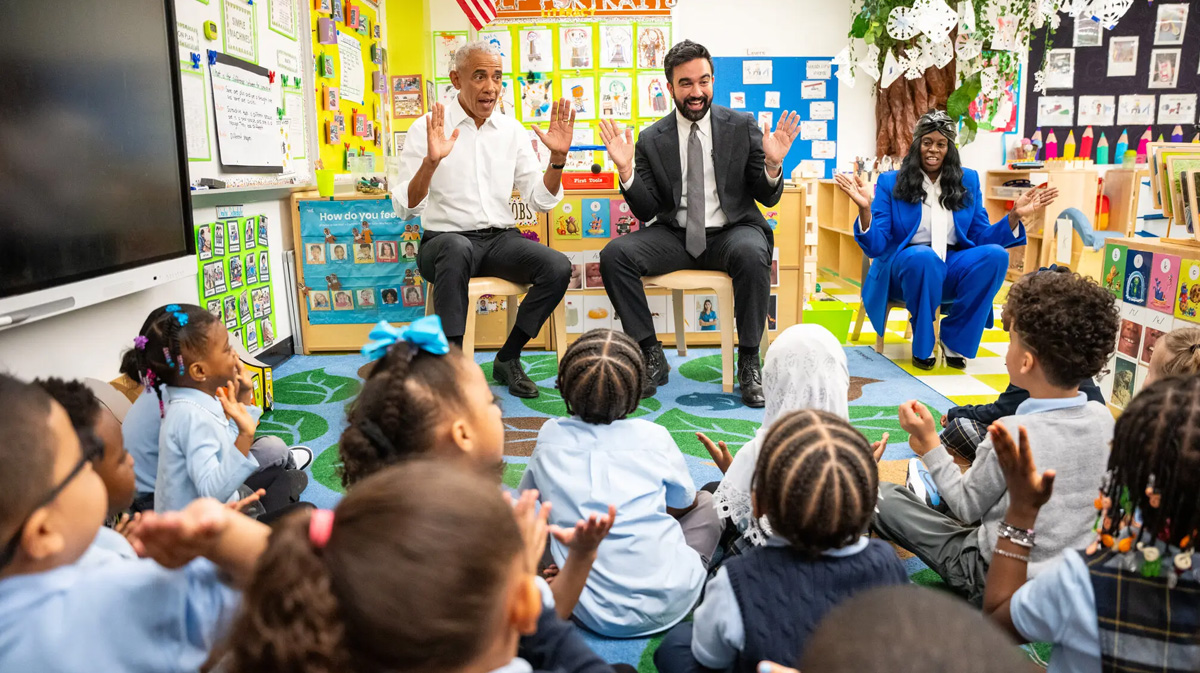
A circle of preschoolers on a Bronx rug became the unlikely center of New York politics when Mayor Zohran Mamdani and former President Barack Obama dropped to the floor for a morning of songs, stories, and soft-focus campaigning. Their easy banter and kid-friendly theatrics were wrapped around a serious message: expanding free child care as a cornerstone of the city’s affordability agenda.
The visit, their first public appearance together, unfolded at the Learning Through Play Pre‑K Center, part of New York City’s free preschool network for three- and four-year-olds. Children watched as a former president and a newly minted mayor joined in a spirited rendition of “Wheels on the Bus,” then leaned in for a picture book about community and cooperation. When Obama paused mid-story to ask who had built a sandcastle, a forest of small hands went up—and Mamdani deftly pivoted the moment into a plug for his broader push to make New York more affordable.
Mamdani’s child care plan is the latest chapter in the platform that propelled him into office: a promise to relieve the financial pressure on working families by treating care and transit as public goods. This fall, his administration aims to extend free child care to 2,000 two‑year‑olds, an expansion of the existing universal pre‑K framework. To sell the idea, he has leaned heavily on celebrity power, recruiting figures like Cardi B and Representative Alexandria Ocasio‑Cortez to urge parents to sign up and to frame free child care as a right, not a perk.
Obama’s presence signaled that the campaign has moved onto a bigger stage. The former president did not endorse Mamdani during last year’s mayoral race, but he quietly called him in November, just before Election Day, to offer advice and encouragement. Now, standing before teachers and toddlers, Obama gave a public nod to the initiative, praising the city’s investment in “these amazing kids” and aligning himself with the idea that early childhood programs are core infrastructure, not optional extras.
Inside the classroom, the event played like a warm, lightly scripted duet between two Democratic stars. Obama thanked the educators who keep the center running, while Mamdani used the storybook as a launching pad to talk about housing and affordability. The city released only a vague description of the private conversation that followed—saying the pair discussed Mamdani’s “vision for this city” and the importance of child care—but the public portion made clear that the mayor sees Obama as both validator and mentor as he navigates his first months in office.
Mamdani’s early tenure has been anything but easy. A democratic socialist with an ambitious agenda, he has run headlong into budget constraints and skepticism about some of his signature ideas, including free buses. Yet he has shown a knack for turning potential skeptics into conversational partners, even meeting twice with President Donald Trump at the White House despite sharp ideological differences. The Bronx visit with Obama fit that pattern: a chance to soften ideological edges with humor and shared concern for families.nytimes
The morning also showcased Mamdani’s comfort blending policy with pop culture. When Obama, whose political image is tied to Chicago, asked the class who liked pizza, Mamdani couldn’t resist staging a playful showdown over which city’s slice reigns supreme. “What’s better: New York City pizza or Chicago pizza?” he asked, putting the former president on the spot. Obama dodged with practiced diplomacy, refusing to insult New York’s beloved pies while standing on its home turf.
The generational gap between the two men surfaced in a lighter moment when the children requested “Soda Pop” from the animated film “KPop Demon Hunters.” Mamdani admitted he didn’t know the song, prompting Obama to place a hand on his back and tease that the kids had just made their 34‑year‑old mayor feel “really old.” The exchange drew laughs and underlined the choreography of the day: Obama as seasoned elder statesman, Mamdani as younger, slightly self-deprecating newcomer, both united in trying to look at ease in a room full of four-year-olds.
Their rapport on Saturday glossed over a more complicated history. Some Democrats were initially wary of Mamdani because of his outspoken criticism of Israel, and old social media posts surfaced in which he called Obama “pretty damn evil,” providing ammunition to opponents during the campaign. Obama’s supportive call last November, in which he offered to be a “sounding board” and applauded Mamdani’s discipline under intense scrutiny, helped cool those tensions and suggested a willingness on both sides to move past earlier barbs.
By the time they were trading jokes in the Bronx, any lingering awkwardness seemed buried under mutual flattery and shared political purpose. Obama, a noted music enthusiast, even compared Mamdani—who once rapped under the name Mr. Cardamom—to hitmaking hype man DJ Khaled. The mayor gamely ran with the comparison, tossing back Khaled’s signature phrase “another one,” a knowing wink that folded internet meme culture into a conversation about early education.
Beyond the theatrics, the appearance underscored how central child care has become to Mamdani’s identity as mayor. Free care for toddlers is not just one program among many; it is presented as a pillar of his broader affordability project, which also includes housing and transportation reforms. By staging this event in the Bronx, a borough where working parents often juggle long commutes and high costs, the administration sought to ground its message in the lived realities of the families it hopes to serve.
For Obama, the visit offered a way to reenter domestic policy debates at the municipal level, lending his star power to a cause that aligns with his long-standing emphasis on education and opportunity. For Mamdani, it was a chance to frame his still‑young administration as both bold and practical: willing to dream big about universal child care, but also savvy enough to know that a singalong with a former president can do as much to capture public imagination as any policy paper. In a city where attention is scarce and skepticism abundant, story time on a classroom rug doubled as a soft launch for a tougher political fight still to come.