Victor Glover
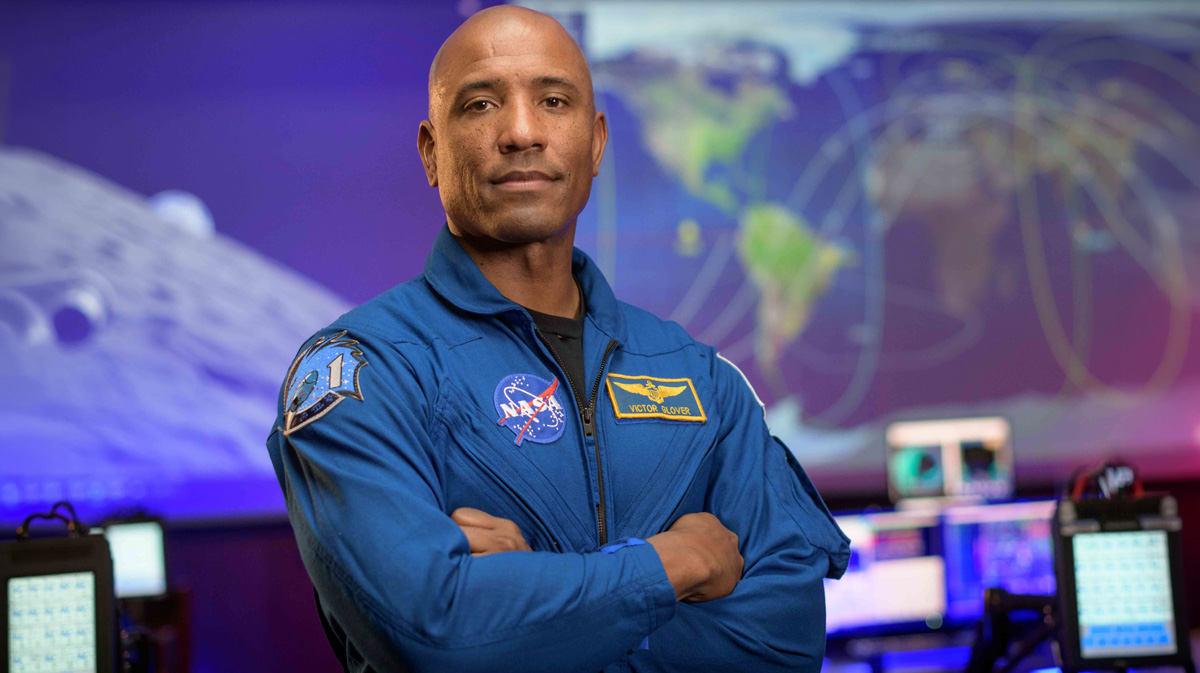
Representing the Culture and the Future of Space Exploration
By R.L. Witter
Victor Glover has become one of the most recognizable faces of NASA’s new era of human space exploration. As a naval aviator, test pilot, and astronaut, his career reflects both technical excellence and a broader cultural shift in who gets to represent spaceflight. His role in the Artemis program places him at the center of humanity’s return to the Moon, a mission designed not only to revisit past achievements, but to build a sustainable presence beyond Earth. He also experienced a viral moment as space enthusiasts watched him take a “zero-gravity shower” with a wet wipe, then proceed to moisturize his entire body to avoid dry skin called “space ash.”
Glover first drew global attention during his time aboard the SpaceX Crew-1 mission in 2020–2021. That flight marked several milestones. It was the first operational crewed mission using a commercially built spacecraft, and Glover became the first Black astronaut to spend an extended period on the International Space Station (ISS). Over the course of nearly six months, he conducted scientific experiments, participated in spacewalks, and helped demonstrate that partnerships between NASA and private companies could redefine how astronauts travel to orbit.
That experience set the stage for his selection to Artemis II, the first crewed mission in the Artemis program. Unlike earlier Moon missions during the Apollo program, Artemis is focused on long-term exploration. The goal is not just to land astronauts briefly, but to establish infrastructure that supports repeated missions and eventually prepares humans for Mars.
Artemis II did not land on the Moon, but it was a critical test flight. The mission took Glover and his crewmates farther from Earth than any human has traveled since 1972, looping around the Moon before returning home, testing life support systems, navigation, and crew operations in deep space, all essential steps before landing missions begin.
Glover’s presence on Artemis II carried symbolic weight as well. Representation in space exploration has historically been limited, and his role signals a shift toward inclusion in one of humanity’s most ambitious endeavors. He has spoken openly about the importance of visibility, not as a personal achievement alone but as a way to expand who feels connected to science, engineering, and exploration. In this sense, Artemis is not just about reaching the Moon again, but about redefining who participates in that journey.
Beyond symbolism, Glover brings practical expertise. His background as a test pilot means he is trained to evaluate complex systems under pressure. Deep space missions involve risks that go far beyond those in low Earth orbit. Communication delays, limited rescue options, and exposure to radiation all demand a high level of discipline and adaptability. Glover’s experience aboard the ISS, combined with his military training, positions him as a key contributor to mission success.
The Artemis program itself represents a major shift in how NASA operates. Instead of working alone, the agency collaborates with international partners and private companies. The European Space Agency, Canadian Space Agency, and Japan Aerospace Exploration Agency are all involved, contributing technology and expertise. This cooperative model reflects a broader understanding that space exploration is a global effort.
Artemis also aims to land the first woman and the first person of color on the Moon, making it a landmark program in terms of diversity. While Artemis II is a precursor mission, it sets the tone for what follows. The success of this flight will directly influence Artemis III, which is expected to achieve the first crewed lunar landing since the Apollo era.
For Glover, the mission is both professional and personal. Like many astronauts, he grew up inspired by earlier space missions, but his journey also reflects more recent changes in access to STEM careers. He often emphasizes teamwork, faith, and perseverance as key factors in his path. Those qualities will be essential as Artemis pushes human spaceflight into a new phase.
When he’s not soaring above the stars, Glover lives in Texas with his wife, Dionna, and their four daughters. He has taken religious items to space, including The Bible and communion cups. Speaking about his faith he has said, “God assigned me a few really important things: this life, this vessel, but also my wife and that relationship, the two of us becoming one, and then the family that we’ve grown with our four daughters.”
In the end, Victor Glover’s role in Artemis highlights a turning point. The mission blends legacy and innovation, drawing on decades of knowledge while embracing new technologies and broader participation. Glover stands as both a skilled astronaut and a symbol of where space exploration is headed.