Faith, Family, Violence, and Redemption
Your Mother Your Mother Your Mother is the kind of film that refuses to remain confined to a single genre. On the surface, it contains the familiar elements of a crime thriller: danger, violence, competing loyalties and a protagonist with a complicated past. Beneath that framework, however, the film becomes a meditation on family, faith, grief, masculinity and moral responsibility. Directed by Bassam Tariq and featuring Mahershala Ali in the central role, the story follows a man whose carefully constructed life begins to collapse after personal tragedy forces him to reconsider who he is and what he owes to the people he loves.
The title itself provides an important key to understanding the film. The repetition of “your mother” places motherhood at the center of a larger conversation about sacrifice and devotion. A mother’s role within a family is often described in sentimental terms, but the film approaches that idea through the consequences of her absence. When a mother is suddenly gone, the emotional architecture of a family can change dramatically. The father and children must navigate a new reality while confronting the void left by someone whose influence may have been greater than anyone fully understood.
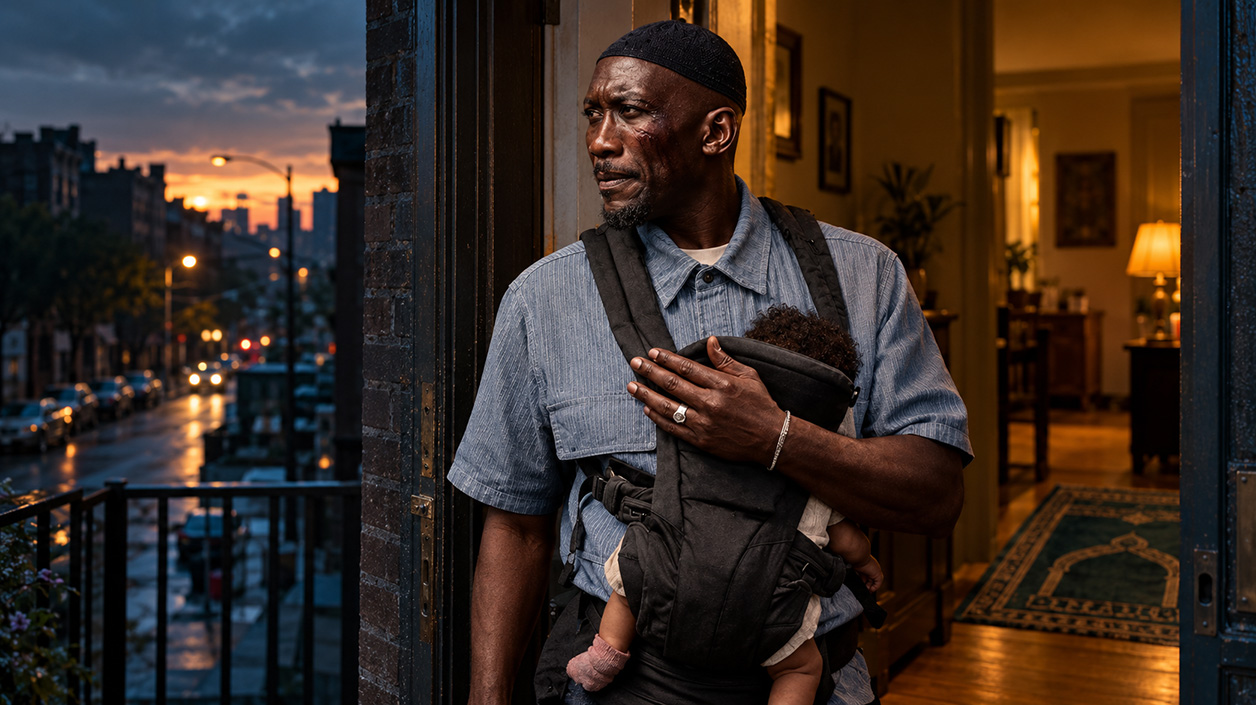
At the center of the story is Latif, portrayed by Mahershala Ali as a man shaped by contradictions. He is a father, a believer and a person capable of extraordinary violence. These identities do not comfortably coexist. His profession has required him to develop a capacity for emotional detachment, yet fatherhood demands precisely the opposite. His children require tenderness, guidance and stability. The death of his wife intensifies that conflict, forcing him to examine the distance between the man he has become and the man he might still have the opportunity to become.
Ali’s performance gives Latif an understated complexity. Rather than relying on exaggerated displays of emotion, he allows silence, facial expressions and physical presence to communicate the character’s internal struggle. There is a weariness in Latif that suggests a man who has spent years carrying burdens he rarely discusses. His strength is real, but so is his vulnerability. That tension makes him compelling because he is not presented as either an uncomplicated hero or a conventional antihero. He is a flawed human being attempting to navigate circumstances that continually challenge his sense of morality.
Fatherhood becomes the film’s emotional counterweight to violence. Latif’s children represent more than people he must protect; they represent the future and the possibility that his life can mean something beyond survival. Every decision carries consequences that extend beyond him. This is one of the film’s most compelling observations about parenthood: the choices adults make in moments of crisis can become part of the inheritance they leave their children. Protecting a family is therefore not simply about keeping danger away. It is also about determining what values, behaviors and memories will be passed to the next generation.
Faith adds an equally significant dimension to Latif’s journey. His Muslim identity is not decorative or incidental. It is part of the moral framework through which he understands his circumstances. Yet his profession and the violence surrounding him create a profound contradiction. The film is interested in that tension rather than offering easy answers. What happens when a person’s beliefs tell him one thing while his circumstances appear to demand another? And what does faith mean when tragedy makes certainty difficult?
The movie also examines the complicated relationship between religion, identity and power. Different characters operate according to competing understandings of morality and authority, demonstrating how belief can inspire compassion but can also be manipulated. The film avoids reducing these conflicts to a simple division between opposing groups. Instead, it suggests that the real danger emerges when individuals use ideology to rationalize their ambitions or violence. That perspective gives the story a contemporary resonance in a world where religious and political identities are frequently used to define who belongs and who does not.
There is also a thoughtful examination of masculinity running beneath the narrative. Latif has been shaped by a culture in which strength is associated with the ability to endure, provide and protect. But the film questions whether traditional ideas about male strength are sufficient when a man is confronted with grief. Latif can confront physical danger, yet emotional vulnerability presents a different kind of challenge. His journey suggests that genuine strength may ultimately require something more difficult than violence: the willingness to acknowledge pain, accept responsibility and change.
Visually and thematically, the film occupies an interesting space between intimate family drama and larger social commentary. The world surrounding Latif is dangerous, but the most consequential battles are often internal. The external threats create tension, while his relationships give that tension meaning. This balance keeps the film from becoming merely another story about a troubled man caught in a criminal world. Its real subject is the human cost of the choices people make when circumstances leave them with imperfect options.
Ultimately, Your Mother Your Mother Your Mother is a film about the possibility of transformation. Latif cannot erase his past, nor can he restore the family life he once knew. What he can do is decide what kind of man he will be from this point forward. That question gives the movie its greatest emotional power. Beneath the violence, religion and suspense is a deeply human story about grief, family and responsibility—and about whether a person who has spent years surviving can finally learn how to live differently.