Patricia Ramsey
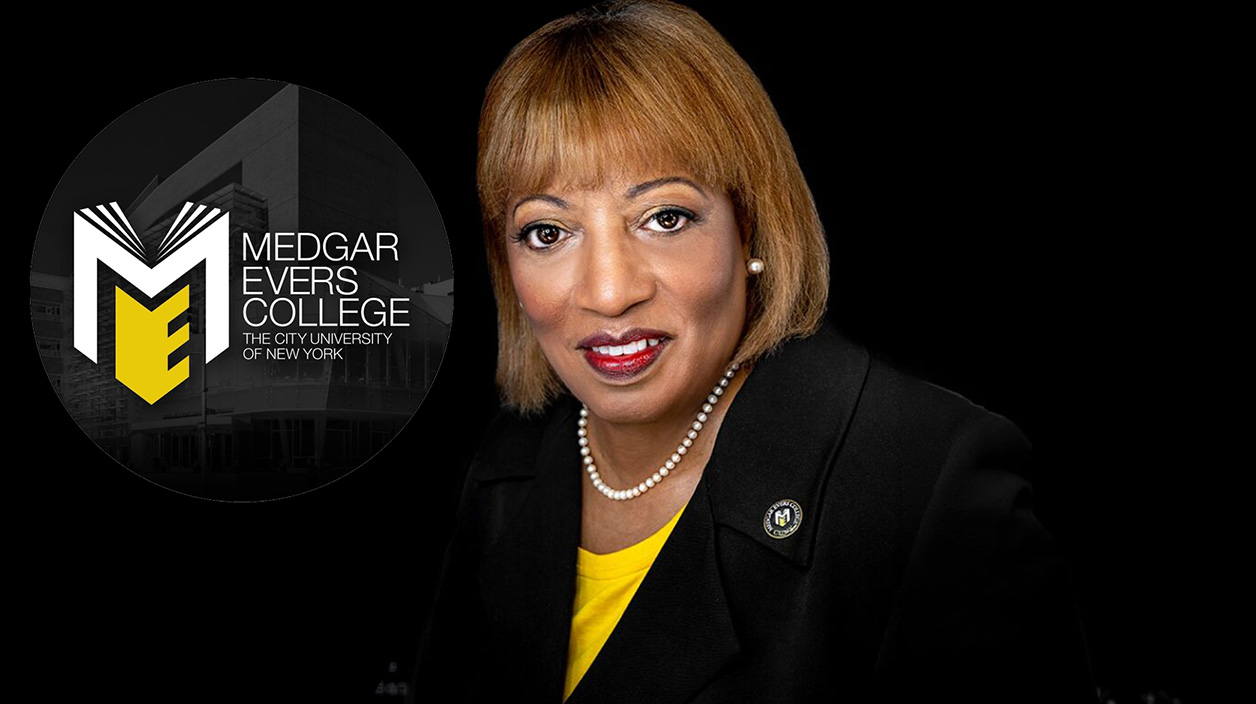
Leading Medgar Evers College with Purpose, Persistence, and Faith
BY R.L. WITTER
When Patricia Ramsey arrived at Medgar Evers College in 2021, she did not come to simply occupy the president’s office. “I came here on a mission,” Ramsey said. From the beginning, she understood that leading the Crown Heights, Brooklyn institution would require more than managing budgets, overseeing academic programs, or representing the college at public events. It would require listening—to students, faculty, staff, and the community, and then turning what she heard into action.
Ramsey had already spent decades building a career in higher education and science. But Medgar Evers College presented something different: an institution whose history and identity are inseparable from the Brooklyn community it serves. And Ramsey, the college’s first woman president and first scientist to hold the position, saw an opportunity to build on that legacy while helping students see new possibilities for their own futures. “I knew I had to hit the ground running,” she recalled of her arrival. And she did.
A First That Meant Something
Ramsey understands the significance of being the first woman to lead Medgar Evers College. As a Black woman scientist in America, she has often found herself in rooms where she was the only Black person or the only woman. Her appointment at Medgar Evers carried a particular significance because of the women watching her. “There were a lot of women in the community who were really excited about the fact that I was the first woman,” she said.
But Ramsey also knew that being the first was only the beginning. Leadership, she believes, is ultimately demonstrated through consistency. At first, she encountered skepticism. Over time, however, that skepticism began to disappear as people saw that she was committed to the college and its community. “A very long term faculty member there, who is now retired, said to me one day, ‘I really do believe you care about this institution,’ and she felt comfortable enough to retire because of it,” Ramsey said.
Putting Students at the Center
One of Ramsey’s earliest priorities was student success. She established a Division of Student Success and began focusing closely on the factors that determine whether students remain enrolled, graduate, and ultimately find meaningful careers. The results have been significant. Enrollment increased by 7.8 percent, while the number of students leaving between the fall and spring semesters dropped dramatically—from roughly 500 students to approximately 63.
Her approach also extends beyond graduation. Ramsey believes the relationship between a college and its students should not end when the diplomas are distributed. “Within the last year we were able to partner with a company as it relates to our students being able to get placed into positions when they graduate,” Ramsey explained. “But not only that, the alumni can also participate.”
Another example is the Brooklyn Recovery Corps, supported through part of a $20 million grant. The program connects students with nonprofit organizations and small businesses for internships and other opportunities. More than 83 community partners have participated. “I knew I wanted to do something to positively impact not just the people who are inside the gates, so to speak, but the community as well,” Ramsey said.
Leading Through Challenge
Ramsey inherited a college facing a $13.5 million deficit. The financial challenge was daunting, but after her first year, the college finished approximately $99,000 in the black. Ramsey is quick to emphasize, however, that financial stability does not mean the institution has suddenly become wealthy. “The budget, the allocation that Medgar Evers gets is less than the institution I left in Maryland was getting back in 2004. So I shared with the chancellor not too long ago that my budget in academic affairs alone, which is one division of the institution, in 2004 had a tax levy budget only $10 million lower than what Medgar Evers is for the whole college in 2026. So it’s a real challenge… and that’s why I’m out there trying to win friends and influence people as best I can to get support for the institution.”
Ramsey has worked with legislators and members of the executive branch to make the case for the college and its students. That advocacy produced a notable milestone when, for the first time, the governor’s executive budget specifically named Medgar Evers College for noncapital support. Even people who may not have agreed with every decision, Ramsey noted, recognized that she was advocating for the institution. For her, that is part of the job.
Where Biology Meets Artificial Intelligence
Under Ramsey’s leadership, Medgar Evers has also embraced an emerging frontier: artificial intelligence. The college has offered a course examining the biology of AI and race, a subject that reflects Ramsey’s interest in the intersection of science, technology, and equity. The questions are consequential. Artificial intelligence systems are increasingly influencing decisions in areas ranging from employment to healthcare, and education. If the data used to develop those systems contain bias, the technology can reproduce—and potentially magnify—that bias.
Medgar Evers has also received $1 million in state funding for a biology and AI research initiative. For Ramsey, this work is part of ensuring students at a Predominantly Black Institution are not merely consumers of emerging technologies. They should be prepared to help shape them.
More Than a College
One of Ramsey’s frustrations is that too many people in Brooklyn still do not know enough about Medgar Evers College. “I found it surprising that a lot of people, for whatever reason, think Medgar Evers is a community college; in my first interview, the person interviewing me thought it was a community college, and I explained it’s not…The largest major at Medgar Evers is in the STEM discipline, which means that it takes more resources because biology—which is the largest major in all of the STEM disciplines—takes more resources.” Ramsey continued, “As a point of pride in this world of AI, we are the first institution in the nation to offer a course in the biology of AI and race.”
The surrounding community is woven into the institution’s governance and mission. Ramsey has embraced that relationship, arguing that a college situated in the heart of a community has an obligation to respond to the needs of that community. Food insecurity has become one important area of focus. The college has partnered with the World Food Movement and worked to provide access to fresh produce. That work reflects something Ramsey says has guided her throughout her life: she thinks about other people first.
A Calling to Advocate
That instinct goes back much further than her presidency. Ramsey recalls a first-grade classmate named Beatrice who needed someone to speak up for her. “I’ve always been this person that was an advocate for other people,” she said. Today, she describes her platforms in much the same way. “I use my platforms for other people.”
It is a philosophy rooted in her faith. Ramsey speaks openly about how faith informs her decisions and her understanding of leadership. One principle she returns to is the familiar instruction to treat others as she would want to be treated. For Ramsey, faith is not something to be separated from professional life. It is part of the lens through which she sees her responsibility to students—particularly those who come from low-income backgrounds and may be navigating obstacles that have little to do with their academic ability. “I feel an obligation,” she said. That obligation extends beyond the campus.
A President Who Wants to Make a Difference
Medgar Evers recently completed its Middle States reaccreditation process, meeting all standards and receiving 17 commendations, with no follow-up required. The accomplishment represents another piece of the larger transformation she has pursued. Ramsey herself serves as a Middle States commissioner, although she recuses herself from CUNY reviews because of the potential conflict of interest.
But her ambitions for Medgar Evers are not limited to accreditation reports, enrollment figures, or balanced budgets. She wants the college to be visible, for Brooklyn to recognize what exists in its midst, and for students to understand their circumstances do not have to determine their futures.
That vision is deeply personal for a woman who, as a child, once dreamed of becoming a college professor; who became a scientist; who conducted research in deserts and forests; and who eventually found herself leading a college whose mission is closely tied to the aspirations of an entire community.
“Even if I didn’t get paid, I would do this job because I want to make a difference for people,” she said. It is a remarkable statement from the president of a college facing the complicated realities of higher education today. Yet it may also be the simplest way to understand Patricia Ramsey.