America’s Conscience At Stanford
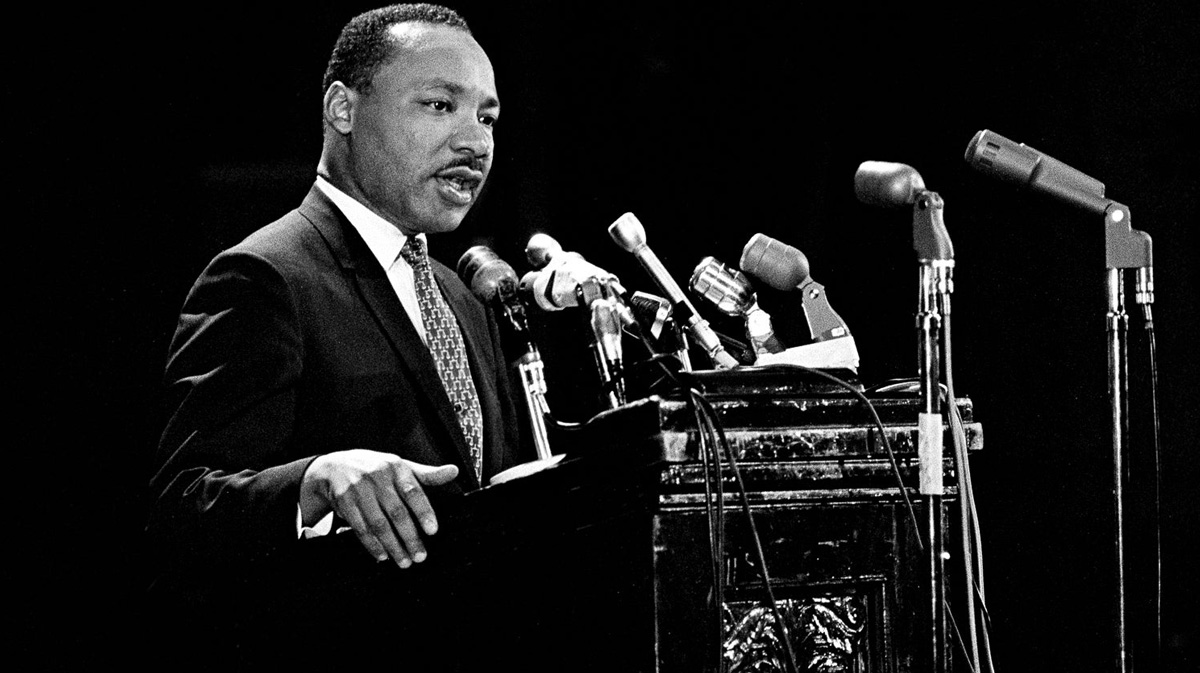
In 1967, Martin Luther King Jr. delivered one of the most powerful speeches of his career at Stanford University. The lecture, often remembered as “The Other America,” challenged the nation to examine its deep racial and economic divisions. By this point in his life, King had already become internationally known for his leadership in the Civil Rights Movement, but his message at Stanford showed an even broader vision. He no longer focused only on segregation in the South. Instead, he confronted poverty, inequality, war, and the moral failures of the entire nation.
King described America as a country divided into “two Americas.” One America enjoyed wealth, education, opportunity, and comfort. This America experienced freedom and prosperity on a daily basis. The other America, however, suffered from unemployment, poor housing, hunger, discrimination, and hopelessness. King argued that millions of Black Americans lived in this second America, cut off from the promises that the nation claimed to uphold. His words forced listeners to face the contradiction between American ideals and American reality.
The speech reflected King’s growing concern with economic justice. Earlier in the Civil Rights Movement, much of the struggle centered on voting rights and ending segregation laws. By 1967, King believed that legal equality alone was not enough. He understood that many African Americans remained trapped in poverty even after civil rights victories had been won. At Stanford, he emphasized that economic inequality was just as destructive as racial discrimination because it robbed people of dignity and opportunity.
King’s lecture also highlighted the psychological pain caused by poverty and racism. He spoke about children growing up in slums, workers unable to find jobs, and families who lived in constant insecurity. He explained that despair was not simply an emotional condition but the result of systems that denied people access to decent housing, healthcare, and education. King wanted Americans to understand that inequality damaged both the body and the spirit.
Another important theme in the speech was nonviolence. During the late 1960s, riots and racial tensions erupted in many American cities. Some activists questioned whether nonviolence could still work. King defended his philosophy by arguing that violence would only create more hatred and destruction. He believed that lasting social change required moral courage, discipline, and compassion. Even while expressing anger about injustice, he urged people to resist hatred.
King also criticized the nation’s priorities. He believed the United States spent enormous amounts of money on war while ignoring the suffering of poor citizens at home. Around this time, King had become increasingly outspoken against the Vietnam War. He argued that America could not claim to defend freedom overseas while millions of its own citizens lacked freedom from poverty and racism. His speech connected militarism, racism, and economic exploitation as linked problems facing the nation.
The Stanford lecture showed King evolving from a civil rights leader into a broader moral critic of American society. He challenged not only racist laws but also the economic structures that kept people poor. This made some former supporters uncomfortable. Many Americans admired King when he spoke about integration and voting rights, but they resisted his criticism of capitalism, war, and economic inequality. Nevertheless, King refused to soften his message.
Students and young people played an important role in King’s audience at Stanford. College campuses during the 1960s were centers of political debate and activism. King believed that students had the energy and imagination necessary to transform society. He encouraged young Americans to question injustice and to commit themselves to service and social change. His speech inspired many students to become involved in movements for civil rights, peace, and economic justice.
King’s description of the “other America” remains relevant decades later. Many of the problems he identified—poverty, unequal schools, housing discrimination, and racial inequality—still exist in different forms today. His speech continues to be studied because it forces Americans to ask difficult questions about fairness and opportunity. The lecture reminds listeners that progress cannot be measured only by laws passed or speeches celebrated, but by the actual conditions in which people live.
The power of King’s speech came not only from his ideas but also from his language and delivery. He combined the rhythm of a preacher with the precision of a scholar. His words were emotional, poetic, and deeply moral. He spoke with urgency because he believed America stood at a crossroads. The nation could either continue down a path of division and injustice or choose compassion, equality, and shared prosperity.
Less than a year after the Stanford lecture, King was assassinated in Memphis while supporting striking sanitation workers. His death shocked the nation and transformed him into a global symbol of justice and peace. Yet speeches like “The Other America” reveal a side of King that is sometimes overlooked. He was not only a dreamer speaking about racial harmony. He was also a fierce critic of economic inequality and national hypocrisy.
Today, King’s Stanford lecture stands as one of his most important reflections on the condition of America. It challenged citizens to recognize that freedom and prosperity mean little if they are available only to some people. King believed the nation’s greatness depended on its willingness to care for the poor, protect human dignity, and create genuine equality. His message continues to ask Americans a powerful question: Which America will prevail—the America of justice and opportunity, or the America of inequality and neglect?