Education Can Change African Children
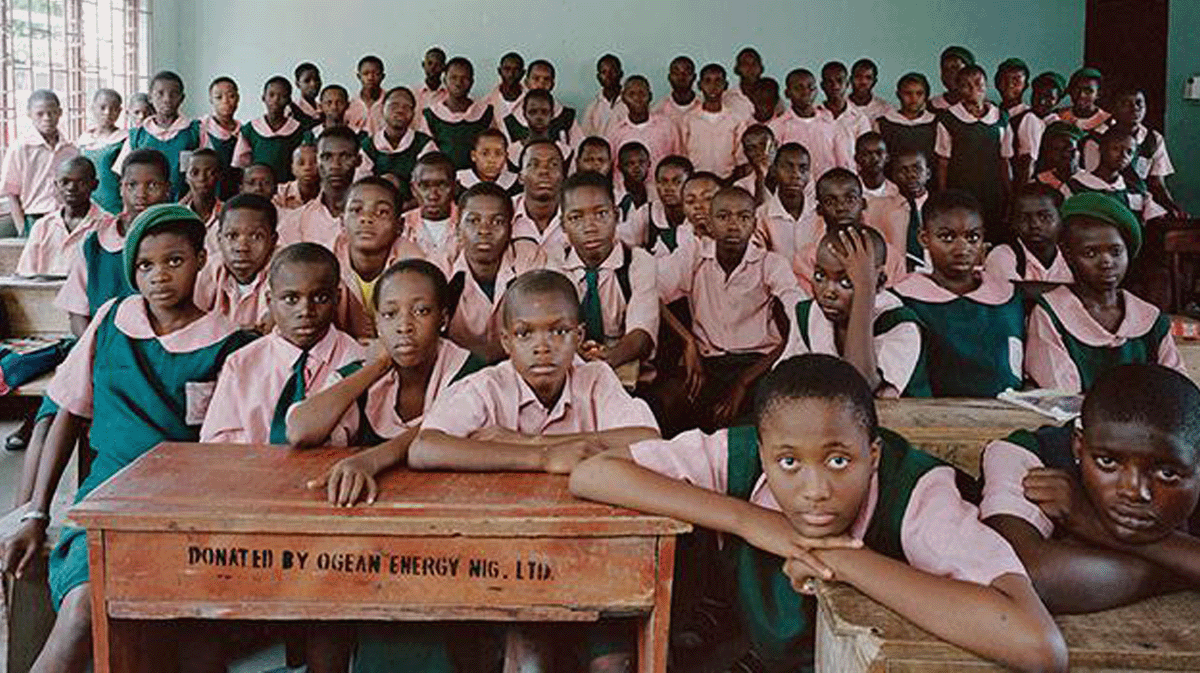
Sometimes changing a child’s life doesn’t begin with a huge government program or a multimillion-dollar organization. Sometimes it begins with one person deciding that a child deserves an opportunity. That simple idea is at the heart of the work being done by the Utu Foundation, an organization dedicated to helping children in Nairobi, Kenya, break the cycle of poverty through education.
The Utu Foundation works primarily in Mukuru kwa Njenga, one of Nairobi’s informal settlements, where many families face tremendous economic challenges. For children growing up in these circumstances, getting an education can be much more complicated than simply showing up at school. Families may have to make difficult choices between school expenses and basic necessities such as food, water and housing.
Utu Foundation believes education can provide a pathway toward a different future. Its work includes sponsoring underserved children to attend high school and helping provide some of the basic necessities that allow them to remain in school. According to information about the organization, it has sponsored more than 50 students, giving young people an opportunity that might otherwise have been out of reach.
The importance of this work goes far beyond paying a school bill. Education can give a young person confidence, skills and the belief that their circumstances do not have to determine their future. A child who is given the opportunity to complete school has a greater chance of pursuing higher education, developing a career and eventually helping support his or her own family.
This is why public awareness matters. When people with a platform introduce their audiences to organizations doing meaningful work, they can help connect causes with people who have the ability and willingness to contribute. Amanda Seales has used her public platform to bring attention to issues affecting Black communities and broader social causes, and her mention of Utu Foundation can help more people discover the organization’s work.
What makes Utu’s mission particularly powerful is that it focuses on children. Children don’t choose the circumstances into which they are born. They don’t choose whether their families have financial resources or whether they grow up in a community with abundant educational opportunities. But with the right support, they can be given the chance to build something different.
Supporting African children also means recognizing that Africa is not simply a continent of need. It is a continent filled with talented, intelligent and ambitious young people. The challenge is often creating access to the resources and opportunities that allow that potential to flourish. Education is one of the most important investments that can be made in that future.
There is also something deeply meaningful about supporting children in their own communities. Rather than simply asking young people to leave their communities to find opportunity elsewhere, educational support can help create future teachers, doctors, entrepreneurs, engineers, artists and community leaders who can eventually strengthen the places where they grew up.
For donors, that means even a contribution that may seem modest can become part of something much larger. The Utu Foundation’s fundraising model demonstrates how people around the world can participate in changing the trajectory of a child’s life. A donation can help with tuition, school supplies and other expenses that might otherwise prevent a young person from continuing his or her education.
For African Americans and members of the African diaspora, initiatives like this can also create a meaningful connection between communities separated by geography but connected by history and culture. Supporting children in Africa does not have to be viewed simply as charity. It can also be viewed as an investment in the next generation and in the future of the African continent.
The story of Utu is ultimately about opportunity. It is about looking at a child who may be growing up surrounded by poverty and seeing something beyond those circumstances. It is about saying that where a child starts should not determine where that child ends. Education can open doors that poverty tries to keep closed.
The work also reminds us that philanthropy does not always have to begin with enormous amounts of money. It can begin with awareness. It can begin with sharing a story. It can begin with introducing someone to an organization they had never heard of. And it can grow when enough people decide that helping a child receive an education is worth their investment.
The future of Africa will ultimately be shaped by its young people. Giving those young people access to education, dignity and opportunity is one of the most powerful ways to help shape that future. The work of the Utu Foundation is a reminder that sometimes the greatest investment we can make is not in what a child has today, but in what that child has the opportunity to become tomorrow.