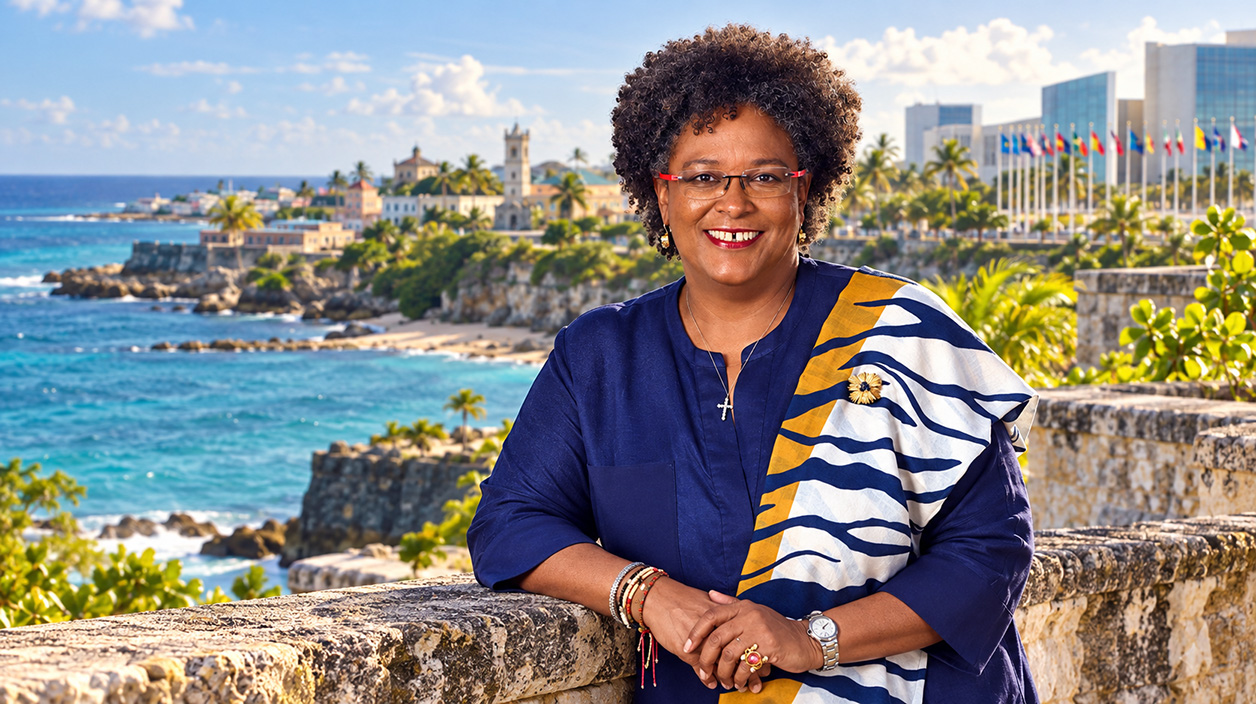
When Mia Amor Mottley became Barbados’ first woman prime minister in 2018, she inherited the task of strengthening a heavily indebted economy while protecting the lives and opportunities of its people. She has since become one of the Caribbean’s most prominent voices abroad, arguing that a nation’s small size should never limit its influence. Her leadership connects two ambitions: making Barbados more resilient at home and making the world more responsive to countries like it.
Economic recovery has been central to her government’s work. Its Barbados Economic Recovery and Transformation program has combined fiscal reform with efforts to rebuild reserves and reduce public debt. The International Monetary Fund reported in 2026 that stronger fiscal accounts had helped put debt on a downward path, though the country still faced the long work of improving productivity and protecting itself against disasters. For Mottley, sound finances are meant to give Barbados room to invest in its future.
Her government has also tried to broaden an economy long dependent on tourism. During the COVID-19 disruption, Mottley introduced the 12-month Welcome Stamp, inviting people employed abroad to live and work remotely in Barbados. It was an inventive response to a sudden loss of visitors and a way to bring spending into the country while travel patterns changed. The program showed her willingness to turn a global shift into a practical opportunity for the island.
Mottley has presented education and health care as measures of national strength. She has called for education reform that gives young Barbadians more useful paths into work and civic life. Her government has also announced plans to expand Queen Elizabeth Hospital’s capacity and upgrade the island’s polyclinics. These initiatives remain work to be judged by their delivery, but they reflect her argument that recovery must reach beyond economic figures into public services people rely on.
Barbados’ transition to a parliamentary republic in 2021 gave that domestic agenda a historic dimension. Under Mottley’s leadership, the country replaced the British monarch as head of state with a Barbadian president. The change did not end the everyday challenges of housing, health, or employment. It did, however, express a conviction that Barbadians should define their own institutions and tell their national story in their own voice.
Climate change has made the limits of national action especially clear. Barbados can strengthen its coastlines and prepare for storms, yet it cannot by itself stop the warming seas and extreme weather that threaten small island states. Mottley has pressed wealthier countries and international lenders to recognize that vulnerable nations need affordable financing before catastrophe strikes. Barbados has also used a climate-resilient debt clause that can create breathing room for recovery after a disaster.
That concern grew into the Bridgetown Initiative, Mottley’s campaign to reform the international financial system. Its proposals seek more effective ways to fund climate adaptation, respond to crises, and help developing countries pursue growth without being overwhelmed by debt. Her challenge is both practical and moral: if the world expects vulnerable nations to protect their people and invest in a cleaner future, its financial rules must give them a fair chance to do so.
Mottley’s view of the world extends beyond climate and finance. At the United Nations in 2025, she defended international cooperation and a rules-based order while warning that distrust and the erosion of shared truth make collective action harder. She has argued that global institutions must respond credibly to conflict and human suffering, as well as to environmental danger. In her account, cooperation is a duty that requires powerful countries to apply their principles consistently.
Her international stature does not remove the pressure to deliver results at home. Barbadians still have reason to measure her government by the cost of living, the quality of services, economic opportunity, and the pace of promised reforms. That tension is part of the story of her leadership: the same prime minister urging the world to change its systems must show how change improves daily life in Barbados. Global recognition and domestic accountability have to advance together.
Mottley’s philosophy rests on the belief that people and countries should have the power to shape their futures, even when history, debt, or geography places obstacles in their way. In Barbados, that has meant pursuing economic repair, public investment, and a stronger sense of national self-determination. On the world stage, it has meant insisting that small states belong at the table where the rules are made. Her enduring test will be whether those ideas produce lasting security and opportunity for the people she serves.