Kwame Onwuachi Cooks His Heritage
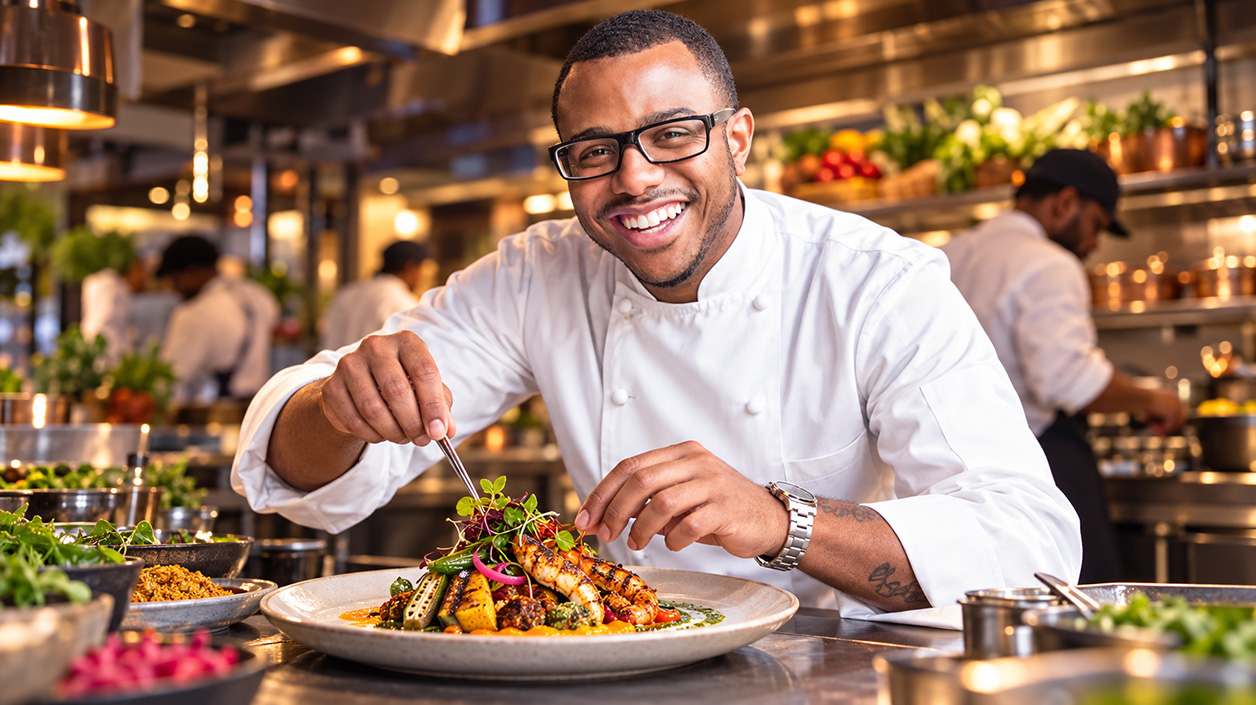
For Kwame Onwuachi, a meal can tell the story of a family, a neighborhood, and a journey across oceans. The chef’s cooking draws from the Bronx, Nigeria, Louisiana, and the wider African diaspora. He brings those influences together with the skill of fine dining and the conviction that the foods he grew up with deserve a prominent place at the table.
Onwuachi’s path to the kitchen was shaped by more than culinary school. His experiences in different communities exposed him to distinct ingredients and ways of cooking, while family food traditions gave those flavors personal meaning. He later trained at the Culinary Institute of America, gaining techniques he could use to express the food memories and cultural history that mattered to him.
His early restaurants in Washington, D.C., brought both attention and difficult lessons. The Shaw Bijou closed after a short run, while Kith/Kin gave him a larger stage for the cuisines of the African diaspora. Those experiences became part of a career defined by persistence and a willingness to reconsider what kind of restaurant he wanted to build.
Onwuachi shared that journey in his memoir, Notes from a Young Black Chef. The book presents the ambition behind his work alongside the setbacks and pressures he encountered. By writing about his life as openly as he cooks from it, he invited readers to consider whose stories the restaurant industry celebrates and whose it too often overlooks.
At Tatiana, which opened at New York’s Lincoln Center in 2022, Onwuachi turned to the tastes and energy of the city that helped raise him. The restaurant honors his New York roots and the culinary legacy of the African diaspora. Its menu draws connections among neighborhood food, Caribbean traditions, Nigerian flavors, and the creativity of contemporary dining.
A dish at Tatiana can feel familiar and surprising at once. Short rib pastrami suya, for example, brings a New York deli tradition into conversation with Nigerian seasoning. Onwuachi’s combinations reflect the way people and food traditions have long met in New York. The result is an expression of the city rather than a collection of separate influences.
He returned to Washington with Dōgon, a restaurant that continued his exploration of Afro-Caribbean food and storytelling. In 2026, he also opened Maroon in Las Vegas, bringing Caribbean flavors to the steakhouse format. Each restaurant has its own setting and menu, but each begins with the belief that cultural history can shape an entire dining experience.
Recognition has followed his work. Onwuachi has received a James Beard Award and was named to Time’s 2025 list of the 100 most influential people. Such honors reflect his success, but his larger contribution is the room he has made for food traditions that have not always received equal respect in celebrated dining rooms.
His writing extends that invitation beyond his restaurants. In My America, he explores how food from the Bronx, the Caribbean, West Africa, and the American South belongs to a fuller understanding of American cuisine. His 2026 cookbook All Hours also makes space for the everyday meals a chef cooks at home, reminding readers that meaningful food need not always be elaborate.
Onwuachi’s career shows what becomes possible when a chef trusts the value of his own history. His restaurants celebrate flavor, but they also ask diners to recognize the people and traditions behind it. Across a memoir, cookbooks, and dining rooms in several cities, Kwame Onwuachi keeps telling that story—one plate at a time.