Facing America’s Future With Honesty
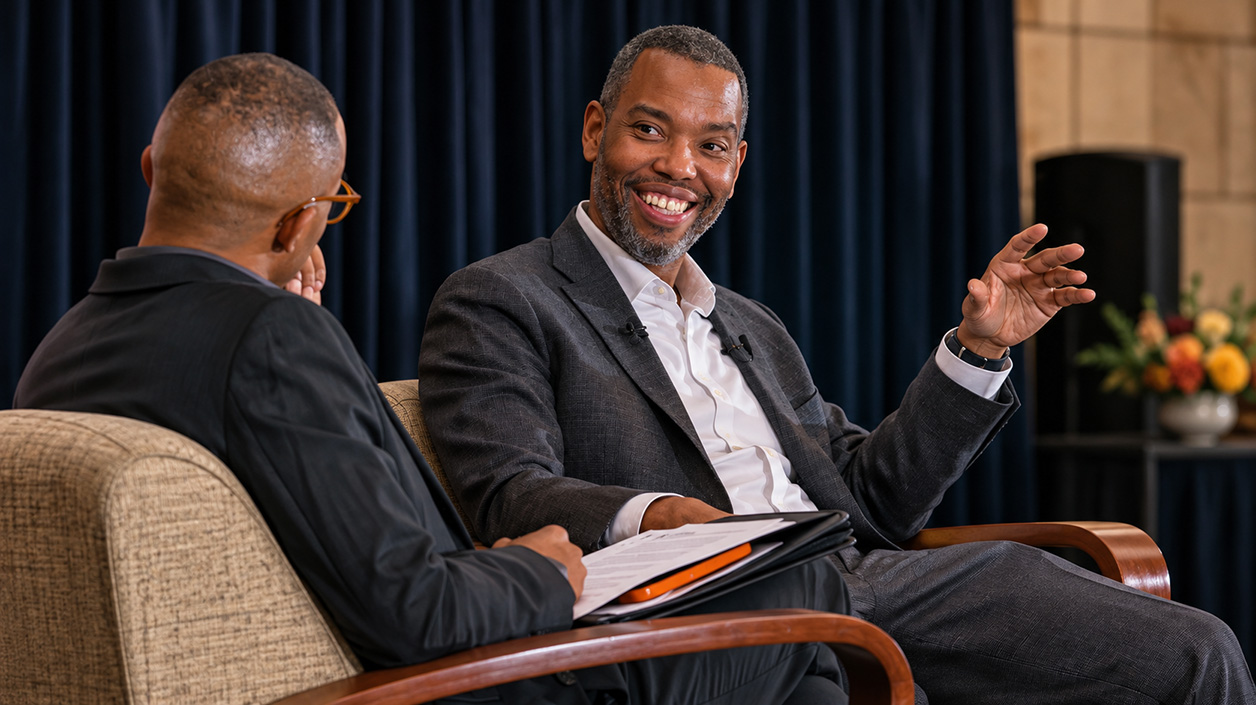
“Where Do We Go From Here? A Conversation with Ta-Nehisi Coates on Race and American Democracy” at Rutgers University–Newark’s Ruth Bader Ginsburg Hall. Presented by the Sheila Y. Oliver Center for Politics and Race in America, the event brought a pressing national question into a local setting. Coming the day after the midterm elections, the gathering offered an opportunity to consider the relationship between political outcomes and the deeper struggle to build an inclusive democracy.
The timing gave the evening’s central question particular weight. An election determines who holds office, but it also invites reflection on whose concerns receive attention and whose needs remain unresolved. For me, attending this conversation meant taking time to think beyond campaign messages and the immediate election cycle. The question “Where do we go from here?” asks something of citizens as well as elected officials: What responsibilities do we accept once the voting ends?
The program brought together university leadership, scholarship, and public participation, with Rutgers–Newark Chancellor Tonya Smith-Jackson and School of Arts and Sciences Dean Jacqueline Mattis listed to deliver opening remarks. Sheila Oliver Center Director and Africana Studies Professor James Jones moderated the conversation with Coates. During the discussion, Coates shared his opinions about Israel, Barack Obama, and Kamala Harris, broadening the evening’s scope to include international affairs and prominent figures in American political life.
Coates brought to the occasion a substantial body of writing about American identity, racial inequality, and national memory. His books include Between the World and Me, winner of the 2015 National Book Award, alongside We Were Eight Years in Power, The Water Dancer, and The Message. Across these works, he connects public questions with personal experience, examining how history influences the stories people inherit and the institutions under which they live.
His discussion of Israel had an important foundation in his earlier reporting. In The Message, published in 2024, Coates examined his travels to Israel and the occupied West Bank, connecting what he witnessed to his understanding of racial domination and segregation. His criticism focused on Palestinian rights, unequal treatment, and the distance between democratic ideals and lived experience. These concerns extended his examination of power beyond the United States while raising questions about America’s role abroad.
In an October 3, 2024, interview on Amanpour & Company, Coates stated, “I believe that what I witnessed was an immoral apartheid regime.” This was an earlier televised statement, rather than a quotation from the Rutgers conversation. His characterization expressed his strong opposition to the system he observed during his visit to Israel and the West Bank. Including that history helps explain why his comments about Israel belong within his broader examination of democracy, equality, and the responsibilities attached to political power.
His earlier writing also provides a framework for considering American democracy. In Between the World and Me, Coates wrote, “But democracy is a forgiving God.” Elsewhere in the book, he observed, “Race is the child of racism, not the father.” Together, these statements challenge readers to examine both national self-image and the institutions that produce inequality. They suggest that democratic language deserves careful scrutiny when people experience exclusion within the systems that claim to represent them.
His 2014 essay “The Case for Reparations” adds another dimension to that examination. Writing in The Atlantic, Coates called for “a national reckoning that would lead to spiritual renewal.” Those words suggest that confronting injustice requires considering how the benefits and burdens of history continue into the present. Alongside his discussion of Obama and Harris at Rutgers, this earlier work offers a useful question for reflection: How should citizens evaluate leadership through policy, accountability, and its consequences for people’s lives?
The setting also mattered. Named in honor of New Jersey’s late lieutenant governor, the Sheila Y. Oliver Center connects scholarship on race and politics with civic engagement and public service. Hosting this conversation in Newark reinforced the importance of making difficult discussions available beyond classrooms and academic publications. Communities need places where residents can examine political choices, hear challenging perspectives, and consider how national and international decisions affect their own understanding of justice.
America’s direction depends partly on political leadership and partly on what people demand, defend, and build within their communities. Coates’s work asks readers to confront uncomfortable histories and apply their principles consistently, including when examining their own country’s actions and alliances. The forum at Rutgers provided an occasion to reflect on that responsibility. Where we go from here will depend on our willingness to turn honest examination into informed participation and lasting public commitment.