Justice Denied on Cherokee Lands
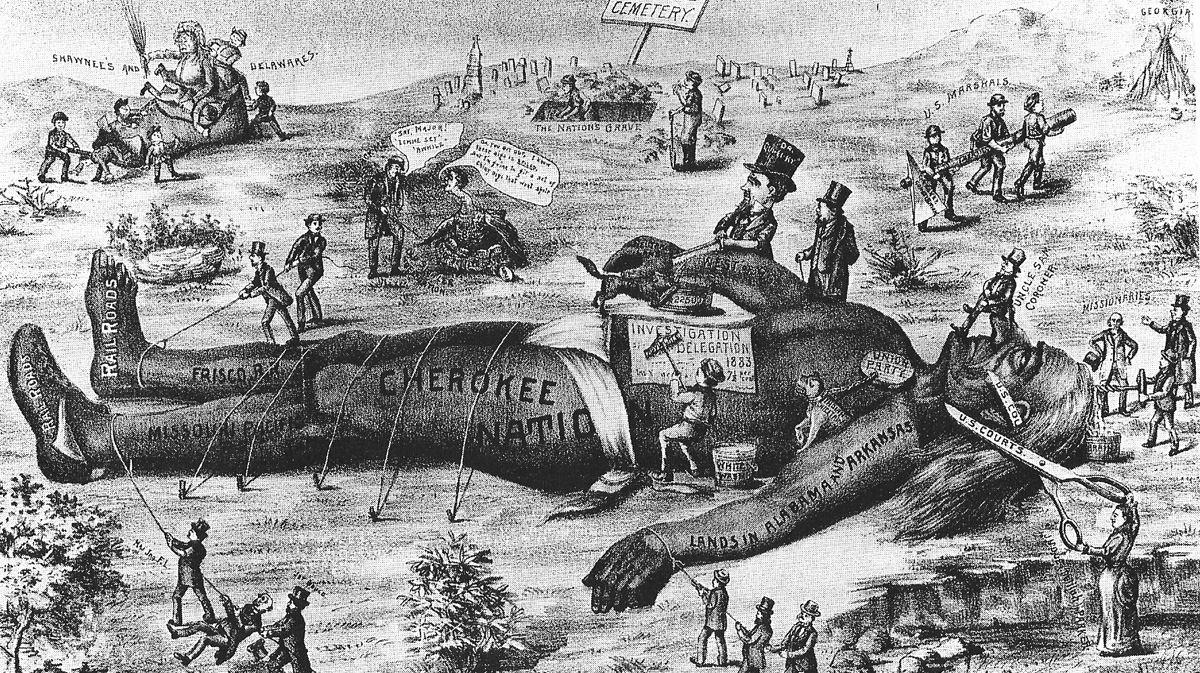
The Cherokee Nation had developed a strong government, written constitution, schools, and farms in what is now the state of Georgia. However, after gold was discovered on Cherokee lands and white settlers demanded access to that territory, Georgia sought to take control of the land and weaken Cherokee self-government.
In 1832, the Supreme Court ruled in Worcester v. Georgia that the Cherokee Nation was a distinct political community and that Georgia had no authority to impose its laws within Cherokee territory. Chief Justice John Marshall declared that relations with Native nations belonged to the federal government, not the states.
For the Cherokee, the ruling appeared to be a major victory. Legally, it confirmed that their lands and government should be protected from Georgia’s interference. Cherokee leaders hoped the decision would secure their right to remain on their ancestral homeland.
In practice, however, the ruling was not effectively enforced. President Andrew Jackson strongly supported Native removal policies and did not ensure that Georgia complied with the Court’s decision. As a result, Georgia continued to pressure the Cherokee people despite the Supreme Court’s ruling.
The removal effort was also driven by the federal government’s policy embodied in the Indian Removal Act, which authorized the relocation of Native nations living east of the Mississippi River. The Cherokee resisted through legal and political means, but growing pressure from state and federal authorities undermined their position.
In 1835, a small group of Cherokees signed the Treaty of New Echota, ceding Cherokee lands in exchange for territory in present-day Oklahoma. Most Cherokees, including Principal Chief John Ross, opposed the treaty and argued that the signers did not represent the Cherokee Nation.
Nevertheless, the federal government used the treaty as legal justification for removal. In 1838, U.S. troops and state militias rounded up thousands of Cherokee men, women, and children and forced them into detention camps before beginning their westward march.
The resulting journey became known as the Trail of Tears. Approximately 16,000 Cherokees were removed, and an estimated 4,000 died from disease, hunger, exposure, and exhaustion during the relocation.
The tragic irony is that Worcester v. Georgia had recognized the Cherokee Nation’s rights and sovereignty, yet those rights were not protected in practice. The case demonstrated that even a favorable Supreme Court ruling could fail when political leaders refused to enforce it.
Today, Worcester v. Georgia and the Trail of Tears are often studied together because they reveal a profound contradiction in American history: a landmark legal victory for Native sovereignty was followed by one of the most devastating forced removals ever carried out by the United States. The case remains a symbol of both the strength of Cherokee resistance and the consequences when the rule of law is not upheld.