Sharswood: When History Came Home
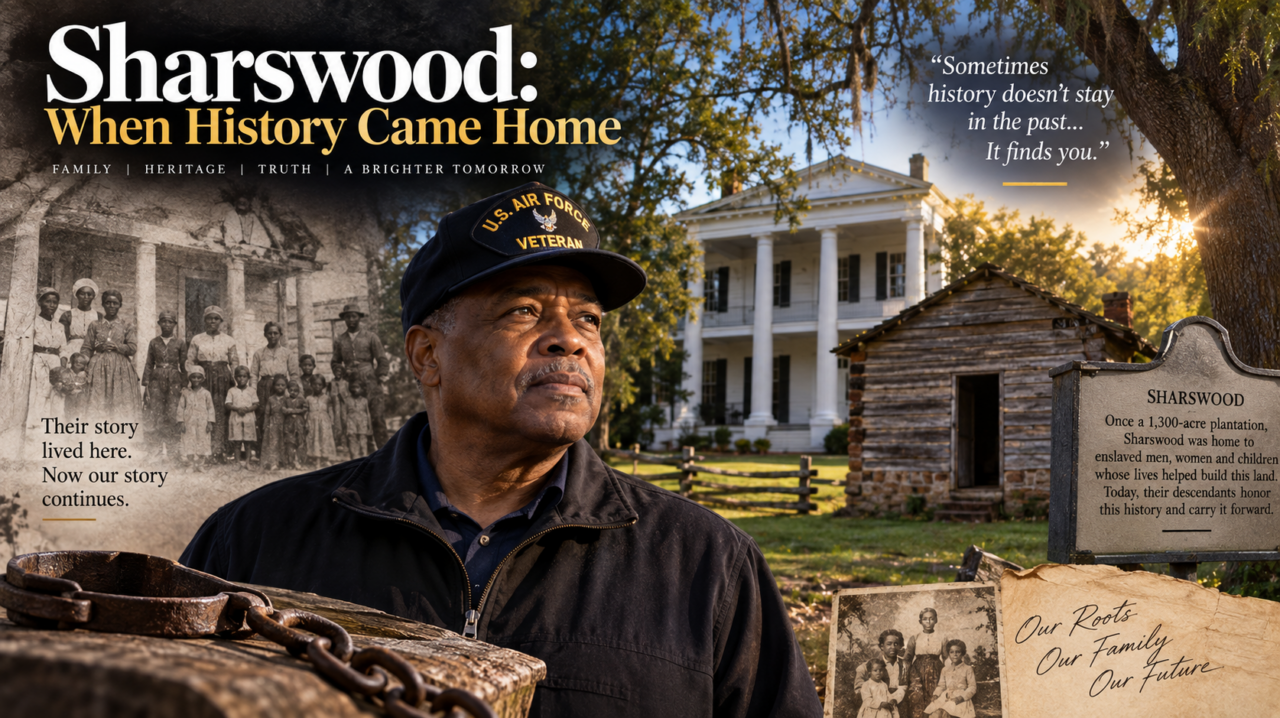
The story of Sharswood is one of the most powerful examples of how history can sometimes find us when we least expect it. Featured on 60 Minutes, the story follows Fred Miller, an Air Force veteran who purchased a large house in southern Virginia because he wanted a place where his extended family could gather. What Miller did not know was that the property had once been a major plantation, and that his own ancestors had been enslaved there.
Miller grew up in Pittsylvania County, Virginia, near the North Carolina border. He had passed the property many times during his childhood but knew very little about the large white house. When his sister Karen Dixon-Rexroth saw the property for sale, she encouraged Fred to purchase it. His original intention was relatively simple: he wanted a large place where his family could celebrate birthdays, have fish fries, play games, and spend time together. He had no idea that buying the house would open a door into his family’s forgotten past.
After the purchase, Karen became fascinated by the history of the property. She began researching the house and discovered that it was called Sharswood and had once been the center of a 1,300-acre plantation. The discovery changed the meaning of the property almost immediately. What Fred had viewed as a beautiful old house for family gatherings was actually a place connected to one of the darkest periods in American history.
The most remarkable discovery was yet to come. Researchers and genealogists helped the Miller family uncover evidence that their ancestors, Violet and David Miller, had been enslaved at Sharswood. Fred had always understood that his family had roots in slavery, as virtually every African American family with deep roots in the South must confront that possibility. But knowing that his ancestors had actually lived and worked on the very property he had purchased transformed slavery from something distant and abstract into something intensely personal.
That realization carries enormous emotional weight. Fred was no longer simply the owner of an old Virginia plantation house. He was now standing in a place where members of his own family had been denied freedom. The same property that had once represented the wealth and power of enslavers had unexpectedly come into the possession of descendants of the people who had been enslaved there. That reversal of history gives the Sharswood story a significance far beyond one family.
The physical evidence on the property makes the story even more powerful. Behind the main house stands a deteriorated building that historians and archaeologists believe was once used as living quarters for enslaved people. Researchers identified architectural features consistent with slave quarters, providing a tangible connection to the people who lived there. For Fred and his family, these were not simply historical structures. They were possible remnants of the lives of their own ancestors.
Perhaps the most emotional discovery involved the cemetery where enslaved people were buried. Fred eventually learned from Bill Thompson, a former owner of the property, where the cemetery was located. When Fred saw the site, he was overwhelmed by the realization that the resting place of his ancestors had been nearby all along. The cemetery represented something that many African Americans have struggled to find: a physical location connected directly to their family history.
For many Black Americans, this is one of the most painful consequences of slavery. Families were separated, records were destroyed or never created, names were changed, and generations were denied the opportunity to preserve their histories. As a result, many African Americans can trace their ancestry only so far before encountering a wall of uncertainty. Sharswood demonstrates what it can mean when that wall is finally broken and a family discovers exactly where some of its ancestors lived.
The story also challenges the traditional way Americans think about historic plantations. For generations, plantation houses have sometimes been presented primarily as examples of beautiful architecture, wealth, or Southern history. But every plantation also has another story—the story of the enslaved people whose labor helped create that wealth. Sharswood forces viewers to look at both sides of that history and recognize that the people who were enslaved were not simply names in old documents. They were human beings with families, emotions, hopes, fears, and descendants.
There is also something deeply symbolic about Fred Miller’s decision to preserve Sharswood. Rather than hide from the property’s painful history, he has embraced the opportunity to make the location a place where people can learn. Since the original 60 Minutes report, Miller has established the Sharswood Foundation to help maintain the slave quarters and cemetery and has begun offering tours of the property.
Perhaps the most meaningful part of the story is that Sharswood has once again become a place where family comes together. Fred originally bought the property because he wanted a gathering place for his relatives. He later discovered that his ancestors had been there under circumstances that were completely different from his family’s gatherings today. His family can now return to the same land not as enslaved people but as descendants who have reclaimed a part of their history.
Ultimately, Sharswood is a story about more than slavery. It is about memory, identity, family, and the power of discovering where you come from. Fred Miller thought he was buying an old house for his family. Instead, he discovered a missing chapter of his family’s history. The story reminds us that America’s past is not really the past when it continues to shape the families and communities living today. At Sharswood, history came home—and in doing so, it gave one family something that slavery had taken from so many: a tangible connection to where they came from.