Baltimore’s History Through Art
Baltimore is a city whose history is filled with triumph, struggle, cultural pride, and artistic expression. Its complex past continues to influence the people who live there, and a new generation of artists is finding meaningful ways to preserve those stories. Through photography, paintings, poetry, and woven artwork, local creatives are presenting a multifaceted portrait of Baltimore and its people.
At the center of this artistic exploration are photographers Devin Allen and Jerrell Gibbs, two Baltimore artists whose work reflects different generations and perspectives. Their artistic relationship is particularly meaningful because they attended the same middle school more than two decades apart. Although their experiences were separated by time, both developed a passion for documenting the people, places, and circumstances that define their hometown.
This fall, the Baltimore Museum of Art is bringing these stories together through three major exhibitions. They include “Flashback: Two Centuries of Baltimore Photography,” “Jerrell Gibbs: Come Home With Me,” and “Diedrick Brackens: Lights at the End of the World,” which also incorporates poetry by Baltimore writer Jéel Diaz. Together, the exhibitions offer visitors different perspectives on the city’s history, identity, and artistic development. Museum director Asma Naeem, who became the institution’s first Baltimore-born director in its 112-year history in 2024, has made highlighting regional artistic excellence an important part of her vision.
One of the most compelling contributions comes from Devin Allen, whose photography captured the historic protests that followed the 2015 death of Freddie Gray. Allen, who had purchased his first camera only two years earlier with financial help from his grandmother, immediately recognized the importance of documenting what was happening in his community. Having grown up in West Baltimore, he understood the emotions, frustrations, and historical circumstances surrounding the demonstrations. His photographs quickly circulated across social media, attracting attention from celebrities and eventually reaching the editors of Time magazine.
On May 11, 2015, one of Allen’s photographs appeared on the cover of Time, bringing national attention to both the protests and his extraordinary talent. The photograph showed a man moving toward a group of protesters while police officers stood behind him. Allen’s images became important historical documents because they offered a perspective from someone who belonged to the community being photographed. Rather than approaching the demonstrations as an outside observer, he was documenting a moment that directly affected the people and neighborhoods he knew. His philosophy was simple: he wanted to tell the truth about Baltimore.
Allen has frequently acknowledged the influence of legendary photographer Gordon Parks, whose work demonstrated how photography could become a powerful instrument for social awareness and change. Since gaining national recognition, Allen has expanded his career, worked with Under Armour, and supported programs that introduce photography to young people throughout Baltimore. His commitment extends beyond taking pictures; he wants the next generation to discover the possibilities of visual storytelling. For Allen, photography is not simply about creating beautiful images but also about giving people the opportunity to represent themselves and their communities.
The museum’s photography exhibition also reaches much further into the past, featuring approximately 210 photographs that explore two centuries of Baltimore history. Among its remarkable selections is an 1841 photograph of Frederick Douglass, taken several years after he escaped slavery. Douglass, who was born in Maryland and spent his formative years in Baltimore, understood the importance of photography in shaping public perception. He believed that images could challenge racist representations of Black Americans and provide people who were historically excluded from political and cultural institutions with a means of presenting their own identities.
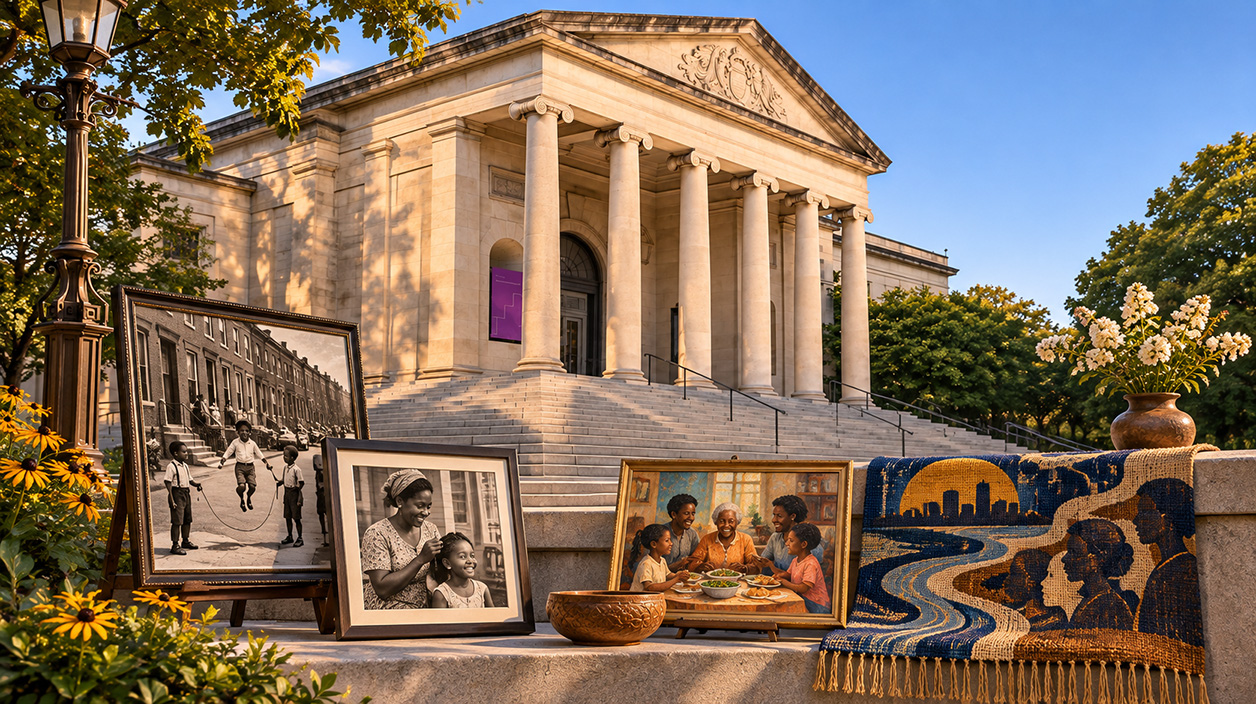
Another memorable photograph is Irving Henry Phillips Sr.‘s 1954 image, “Druid Hill YMCA Swim Class.” It captures a group of young swimmers standing together in a pool, following their instructor’s movements with remarkable coordination. Phillips was an accomplished photographer for the Baltimore Afro-American newspaper, commonly known as The Afro, which was established in 1892 and continues publishing today. His photographs preserve everyday moments that might otherwise disappear from public memory. These images demonstrate that historical significance can be found not only in major political events but also in ordinary experiences that reflect the character of a community.
Jerrell Gibbs approaches Baltimore’s history through painting, drawing inspiration from photographs and personal memories discovered in his family’s home. Growing up in West Baltimore, Gibbs developed a deep appreciation for the people and traditions surrounding him. His paintings explore family gatherings, neighborhood relationships, and the everyday experiences that create a sense of belonging. One particularly meaningful work, “To-Go Plates,” celebrates his grandmother’s generosity and the Sunday meals she regularly prepared for neighbors. Her home was a gathering place where food represented more than nourishment; it symbolized hospitality, family, and the importance of looking after one another.
The exhibition also features the woven artwork of Diedrick Brackens, whose work explores the relationship between personal identity, history, and the broader cultural landscape. Drawing inspiration from the American South and the Chesapeake region, his tapestries incorporate themes connected to Black history, memory, and the natural environment. His collaboration with Baltimore poet Jéel Diaz adds another dimension to the exhibition, bringing written expression into conversation with visual art. Ultimately, these exhibitions demonstrate that Baltimore’s history cannot be understood through a single story or perspective. Through photography, painting, poetry, and weaving, these artists are preserving the city’s memories while challenging audiences to reconsider its past. Their work reminds us that art is not merely a reflection of history; it is also a powerful way to preserve identity, honor community, and ensure that future generations understand the stories that shaped the world around them.