Hank Willis Thomas Reframes America
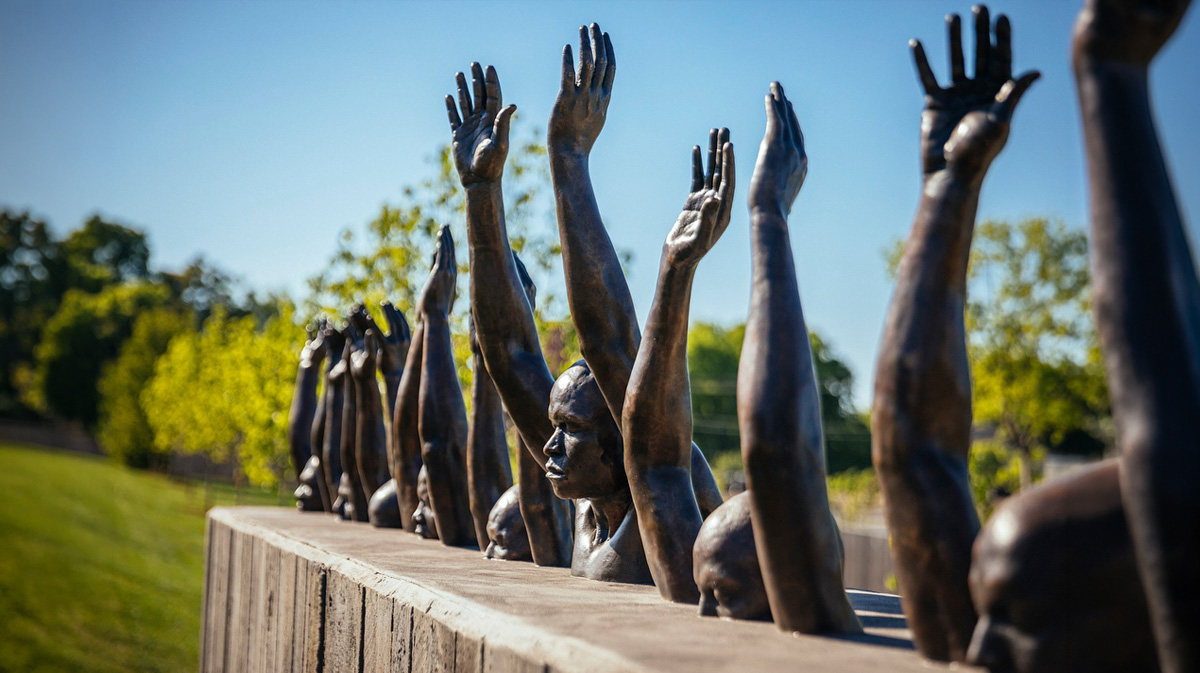
Hank Willis Thomas has built one of contemporary art’s most provocative bodies of work by asking viewers to reconsider images they may think they already understand. Born in Plainfield, New Jersey, in 1976, Thomas is a conceptual artist whose work explores identity, race, advertising, commodity, media, perspective, and popular culture. Working across photography, sculpture, textiles, installation, screen-printing, neon, and public art, he frequently transforms familiar visual language into something that demands a second look.
Photography provides an important foundation for Thomas’s artistic vision. He earned a B.F.A. from New York University and later received an M.A. and M.F.A. from California College of the Arts. His photographic training helped sharpen his understanding of how images influence perception—not simply documenting the world, but helping determine how people understand themselves and one another. Thomas has described an approach resembling that of a visual cultural archaeologist, examining images for the assumptions and histories buried beneath their surfaces.
Advertising has become one of Thomas’s most powerful sources of artistic material. Commercial images surround Americans every day, often appearing so familiar that their deeper messages go unquestioned. Thomas strips away that familiarity. By appropriating and altering the visual vocabulary of advertisements, logos, sports marketing, and popular entertainment, he exposes the ways race, gender, power, desire, and consumption can become intertwined. His work challenges audiences to consider not only what an advertisement is selling, but also what ideas about human beings are being sold along with the product.
His celebrated Unbranded series is particularly revealing. Thomas revisited historical advertisements and digitally removed their logos and advertising copy, leaving viewers to confront the people, poses, environments, and racial assumptions within the original images. Without the reassuring presence of a brand name or slogan, the advertisements become cultural evidence. The project demonstrates how marketing can reflect—and reinforce—ideas about race, class, beauty, gender, success, and belonging.
Thomas has also examined the commercialization and objectification of Black male bodies, particularly through the imagery of professional sports. Some of his works appropriate the language of athletic advertising and corporate branding to draw connections between commerce, racial history, celebrity, and physical labor. The results can be deliberately uncomfortable. Images associated with athletic achievement and consumer aspiration become invitations to consider who controls an image, who profits from it, and how historical forms of exploitation can echo within contemporary culture.
Yet Thomas’s career extends far beyond individual works hanging on museum walls. Collaboration and public participation are central to his practice. His projects have included Question Bridge: Black Males, In Search of the Truth (The Truth Booth), The Writing on the Wall, and For Freedoms. These initiatives expand the role of the artist from image-maker to facilitator, creating spaces where communities can participate in conversations about identity, democracy, justice, freedom, and representation.
In 2016, Thomas co-founded For Freedoms, an artist-led initiative devoted to creative civic engagement. Inspired in part by Norman Rockwell’s interpretation of President Franklin D. Roosevelt’s Four Freedoms, the organization has used photography, billboards, exhibitions, public programs, and other forms of creative expression to encourage Americans to think about what freedom means in contemporary society. The project reflects Thomas’s conviction that art can function not merely as an object to observe, but as a catalyst for conversation and civic participation.
Thomas’s interest in history, memory, and public space reached monumental scale with The Embrace. Installed on Boston Common, the massive bronze memorial was inspired by a photograph of Dr. Martin Luther King Jr. and Coretta Scott King embracing after King received the Nobel Peace Prize in 1964. Rather than creating a conventional figurative monument, Thomas focused on the intertwined arms and hands of the couple. The sculpture transforms an intimate gesture of affection into a public statement about partnership, sacrifice, equality, and the collective struggle for justice.
Thomas has earned significant recognition during his career, including a Guggenheim Fellowship, Gordon Parks Foundation Fellowship, AIMIA | AGO Photography Prize, and Soros Equality Fellowship. His work has been exhibited internationally at institutions including the International Center of Photography, Guggenheim Museum Bilbao, Musée du quai Branly, and other major cultural institutions. His work is also represented in prominent museum collections, including the National Gallery of Art.
What makes Hank Willis Thomas especially compelling is his ability to make familiar imagery unfamiliar again. A logo, advertisement, photograph, monument, slogan, or gesture can become something entirely different when Thomas changes its context. His art reminds us that images are never entirely neutral: they carry histories, assumptions, ambitions, prejudices, and possibilities. By encouraging audiences to question what they see—and why they see it that way—Thomas transforms looking into an act of inquiry. His work ultimately asks viewers to become more conscious participants in the visual culture shaping American life.