Osage Nation, Oil, Murder, and Memory
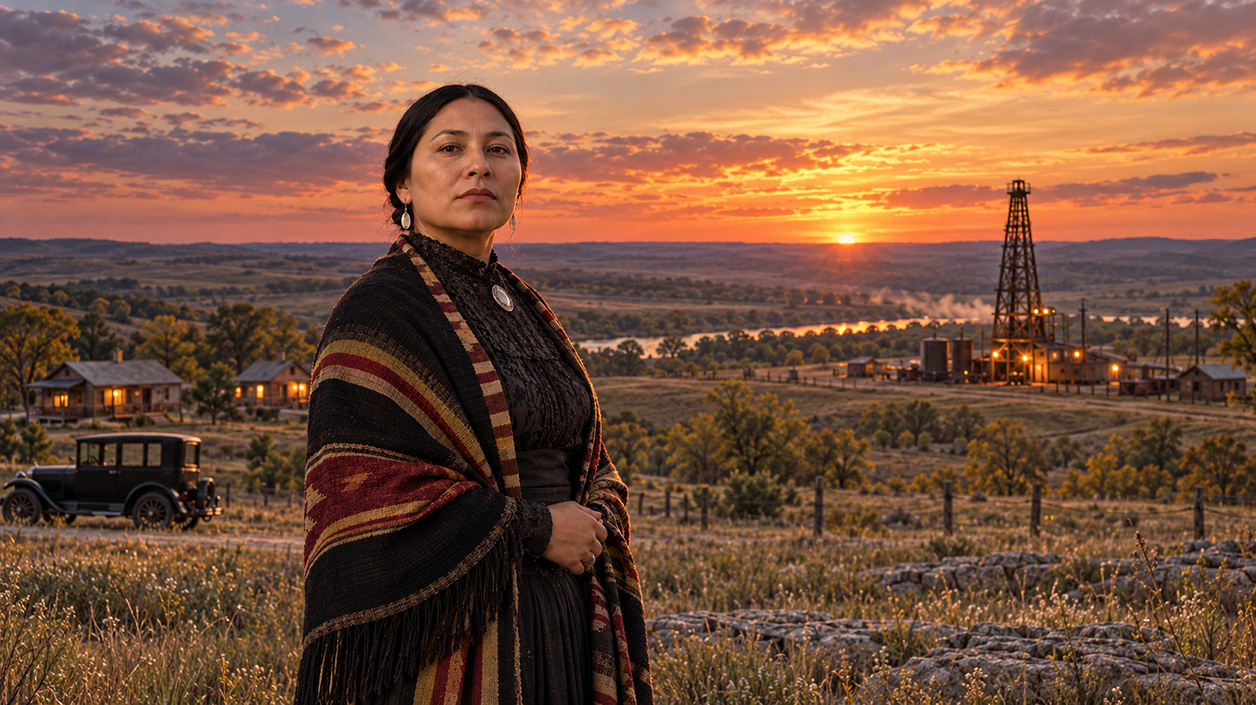
The Osage Nation has a long and complex history that stretches across the central United States. The Osage people originally inhabited large areas of what are now Missouri, Arkansas, Kansas and Oklahoma before being pushed westward through a series of treaties and federal policies. In 1872, the Osage purchased about 1.5 million acres in what is now northeastern Oklahoma, establishing what became the Osage Reservation. Unlike many Native nations, the Osage retained important rights to the minerals beneath their land, a decision that would eventually transform their lives.
The discovery of oil beneath Osage territory in the late 19th and early 20th centuries dramatically changed the economic circumstances of the tribe. The Osage retained communal ownership of the mineral resources, while individual tribal members received what were known as “headrights,” shares of the revenue generated from oil and gas. As petroleum production expanded, Osage families received enormous royalties, and some Osage became among the wealthiest people in the world on a per-capita basis.
But this newfound wealth also attracted people who wanted to take it away. Federal policies placed many Osage people under guardianship, particularly when government officials classified them as supposedly incapable of managing their own finances. White guardians, lawyers, businessmen and other outsiders gained access to Osage money. The combination of racial prejudice, government control and enormous oil wealth created an environment in which exploitation could flourish.
During the 1920s, a series of murders began to reveal the terrible consequences of that system. In May 1921, the body of Anna Brown, an Osage woman, was discovered in a ravine. She had been shot in the back of the head. Her death initially went largely unsolved. Soon afterward, members of her family and other Osage people began dying under suspicious circumstances. Anna’s mother, Lizzie Q, died, followed by the murder of Henry Roan and the bombing of the home of Rita and Bill Smith.
The growing number of deaths created an atmosphere of fear throughout Osage County. Newspapers eventually described the period as the “Reign of Terror.” At least two dozen people died under suspicious circumstances, although later research has suggested that the actual number of victims may have been substantially higher. Some deaths were never properly investigated, meaning that the full scale of the tragedy may never be known.
One of the central figures in this history was Mollie Burkhart. Mollie was a member of an Osage family whose relatives were among those killed. She was married to Ernest Burkhart, whose uncle, William Hale, was a powerful local rancher and businessman. Investigators eventually concluded that Hale had organized a conspiracy involving the murder of Osage people for financial gain. Ernest also became deeply involved in the conspiracy surrounding his wife’s family.
The case eventually attracted federal attention, but the investigation did not happen quickly. The Osage themselves pushed the federal government to act and even provided money to help finance an investigation. In 1925, federal officials assigned former Texas Ranger Tom White to lead the investigation. White and his team used undercover agents and reexamined evidence and witnesses, eventually building a case against Hale and others.
The investigation became one of the important early cases associated with the federal Bureau of Investigation, the agency that later became the FBI. The investigators uncovered evidence connecting William Hale and Ernest Burkhart to the murders. Hale was eventually convicted for his role in the killing of Henry Roan, while Ernest Burkhart pleaded guilty to participating in the murder conspiracy. The federal government’s successful prosecution brought some accountability, but it did not solve every suspicious death associated with the period.
More than 90 years later, journalist David Grann revisited the history in his 2017 nonfiction book Killers of the Flower Moon: The Osage Murders and the Birth of the FBI. Grann’s research went beyond the FBI’s original investigation, examining archival records and speaking with Osage descendants. His work raised questions about how many victims there actually were and how much of the broader conspiracy was never fully exposed or prosecuted.
Martin Scorsese’s 2023 film Killers of the Flower Moon adapted Grann’s book for the screen. The movie stars Lily Gladstone as Mollie Burkhart, Leonardo DiCaprio as Ernest Burkhart, Robert De Niro as William Hale and Jesse Plemons as FBI investigator Tom White. Rather than treating the story simply as an FBI detective story, the film places considerable emphasis on the relationship between Mollie and Ernest and on the betrayal taking place inside Mollie’s own family.
The film was also significant because Osage people were directly involved in discussions surrounding the production and representation of their history. Members of the Osage community participated in the film’s development and public events. Their involvement helped bring greater attention to the importance of telling the story from the perspective of the people whose families experienced the murders and exploitation.
Ultimately, the history of the Osage Nation is much larger than the murders depicted in Killers of the Flower Moon. The Reign of Terror was rooted in a longer history of land dispossession, racial discrimination, government control and attempts to exploit Native wealth. The story is also one of Osage perseverance: despite tremendous loss, the Osage Nation survived and continues to maintain its government, culture, traditions and identity. The movie brought international attention to a history that had been overlooked for generations, while the continuing work of Osage historians and descendants ensures that the victims are remembered as people rather than simply as names in a criminal case.