PJ Morton Interview

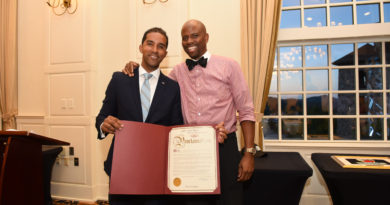
5 time Grammy Award winner, PJ Morton sits down with Tirade World to unpack his latest project, ‘Cape Town to Cairo’. Recorded in 30 days across 5 countries in Africa, the singer, songwriter and pianist, explores identity, perseverance and evolution.
Congrats brand new project, ‘Cape Town to Cairo’. You set yourself a 30-day challenge to record an album in Africa, what inspired this?
I think a number of things. One, the motivation was wanting to go to Africa. I hadn’t really been outside of North Africa so I wanted to connect with where my ancestors were from. Then once I got the idea of collaborating with artists in Africa, it just kept getting bigger and bigger. I watched some stuff on Paul Simon’s album, Graceland, that he did in South Africa. One of the things that I noticed was the backlash he got; he went and got the sauce, got the rhythms, got some of the sounds and then went back to finish it. So I was like, I love that he did that but I want to make sure that I create fully on the continent, as opposed to taking the vibes and then processing them later. So that’s how the 30 days became a thing and it exceeded all my expectations.
The 30 days wasn’t just recording. You were everywhere! You did South African Idol. You went to Elmina Castle. You were at Mandela’s residents. What was the most defining point of the trip for you?
I think there were many – it’s hard to pick because I did multiple countries as well. In South Africa, it was working at Constitution Hill, where Mandela was imprisoned. They turned part of it into a recording studio called Flame Studios. I worked there and feeling that was crazy. My highlight in Lagos was going to Felabration; we landed in Lagos on Fela’s birthday so it was the last day of celebration. That was an experience! In Ghana, we went to the [slave] dungeons and the castle. We’ve always known that these people were taken and, and brought to the new world, but to actually physically see it was something different. I would say those were some big ones for me.
You vlogged the entire experience which was beautiful to see!
Yeah, we’re actually working on the proper documentary but this was daily vlogs just to show what we were doing. I wanted in real time to show everybody what was happening while I was experiencing it. The documentary is going to be a little more in depth; showing me writing the songs etc. We go back to Africa in September to tour Nigeria, Ghana, Kenya and three places in South Africa, so in the documentary, I want to show us going back to perform the songs that we created there.
We really got to see another side of you! Let’s dig a little deeper. You started playing keys at the age of 8 and your first singing performance was at 14 but you were heavily inspired by your sister’s cassette with the Beatles.
Talk to us about that?
When my little sister was born there was a lullaby tape that just had multiple different songs on it. It had the Beatles ‘Hey Jude’, ‘Yesterday’ and more – I was like drawn to those melodies. My mum started telling me stories about The Beatles. The first thing that hit me was that Paul McCartney’s name. His name is Paul. My name is Paul. I probably could do what he does; that kind of started a lifelong love for the Beatles. I didn’t make it to London until after [Hurricane] Katrina. I brought my band members here and we were right around the corner from Abbey Road [Studios] – that was a full circle moment.
Shoutout to Mum. I’m a big fan of your dad too: Bishop Paul S Morton. It was interesting for me to find out that you’re a PK (Pastor’s kid), but he is too!
Yeah, he’s also a PK. His dad was amazing. My dad lost his dad when he was 12 so I never got to meet my grandfather, but he was such a huge figure in Detroit and Windsor, Ontario – where my dad’s from. He was one of the first pastors to have church locations in both Canada and the US. My dad was highly inspired by his dad and kept it going.
If I ask Siri to play ‘Humble Yourself’, what does that song mean to you?
Oh wow! That was my first solo my first solo with the choir. I was actually very shy as a singer. I mean very shy. That was before I was even playing keys so I hadn’t found my security blanket which became the keys; I would just hide behind that. I remember my dad, making sure I got it right. Rehearsing it over and over till I was in tears, like Joe Jackson without the hitting! He just wanted the best for me. I remember all the ad libs and everything because he gave them to me. [Sings] If you need a doctor, if you need a lawyer…
I love the big band elements. In the daily vlogs, we actually caught the moment where you met Femi and Made Kuti, Fela’s son and grandson at Felabration. Made is on the project – was he an artist you already had your eyes on?
What’s so crazy about working on something in 30 days is everybody had to buy into the 30 days. So everything was double speed, triple speed. Literally, in that daily vlog, when I met Made, that was my first time meeting him. We started to talk after! I wrote ‘Smoke and Mirrors’, ‘Who You Are’ and ‘All the Dreamers’ the Day after Felabration. It was electric. I was so inspired. I reached out to Made, he loved it and hopped on ‘Who You Are’.
You’re touring with this project, how did you pick the locations?
The good thing is that we’ve been touring for many years! Touring has been my lifeline. When I couldn’t get on the radio, when I couldn’t get to a mass amount of people, I was underground, doing shows! Our live show was our best promotion; the most accessible promotion. So a lot of the stops are our core cities, and we’ve added some we’ve been able to grow! Africa is new for us to be touring the way we are. We get to start the tour off in London!
A crowd favourite is ‘How Deep Is Your Love?’ which is a cover. If you were gonna rewind time and pick another song to remake what would it be?
What’s so funny is that was a random pick. I was asking people for covers, and then I ended up looking up the top 20 songs of all time. ‘How Deep Is Your Love?’ was there and I was like, “I love that song” so it just happened. I didn’t overthink it. I generally don’t like to cover Stevie songs because it just sounds like I’m trying too much like Stevie and it’s just not as good. I would probably go with The Beatles like ‘Strawberry Fields Forever’ or ‘Yesterday’ which is such a classic aura. Oh! I could do ‘Here Comes the Sun’ which is one of my favorites as well.
I can hear each one of them now! One of my favourite songs of your is ‘Say So’ featuring JoJo but I heard that when you reached out, you were sitting on read for a minute. What happened?
I think Jo was working on something or she was just getting out of her deal at that time. I had an original version of ‘Say So’ that I released but then I started to rethink it so I reached out but yes, she didn’t see it. And We eventually ran into each other and she’s like, “Oh, let me go look for it” and the rest is history!
We love a great collab. Have you got any other African artists in mind?
I mean, there’s so many. I want to work with Tems for sure. I think she’s special. I’m feeling Gyakie that I talked to in Ghana!
Diving into the project! Starting with ‘Smoke and Mirrors’. The song to me is about deception. What does it mean to you?
I like to hear people’s perspectives because I do think that once you put out songs, they’re not your own anymore. They become whatever your perception of it is. For me, it was kind of twofold. It’s talking about my history and my experience in the music business. A lot of the things that I would search for or aspire to be, weren’t quite what I thought they were. Once I started to break them down, it’s like, “Oh, that’s how they got that”, or “That’s how they were big”, or “That’s how that song was big”. I don’t necessarily want it that way. It’s so much smoke and mirrors. How many times do we see artists who had hit songs, and then we see them 10 years later saying “I was actually broke” but we don’t see broke executives ever so it was partly that. Then it was partly, I felt like I was lied to about Africa. Everything people showed me or what I was taught in school, or what I saw on the books, the way they portrayed Africans is not true. Nigerians get a bad rap in the sense of aggressive. I understand it, it’s like New Yorkers get a bad rap of being rude or mean. The beauty of Africa – being in Cape Town, seeing these mountains; nobody showed me this, nobody showed us this! In real time, the blindfold was being pulled off.
I love that. Have you ever done any DNA testing – do you know your heritage?
We’re about to do my African ancestry. We’re going to have that as a part of the documentary.
Based on where you’ve been, do you have an affinity to one country more than the other?
Yeah, West Africa, for sure. I can’t even say that. South Africa, I fell in love with. The people were just so warm. It was beautiful. I loved it all, to be honest. Nigeria, is what I connected to most as far as the history of the music, the lineage. You start with a lot, but then you end up at Tems, Burna Boy, Wizkid and Tiwa [Savage], Fireboy. I mean, the list goes on. There is so much just in Lagos. And the food! The spice of the food reminded me of home a lot. Then Ghana, the people. I mean, when they said “Welcome home”, I like felt it deeply. The places I went to I really connected with and in a deep way for different reasons.