Drummer Jack DeJohnette
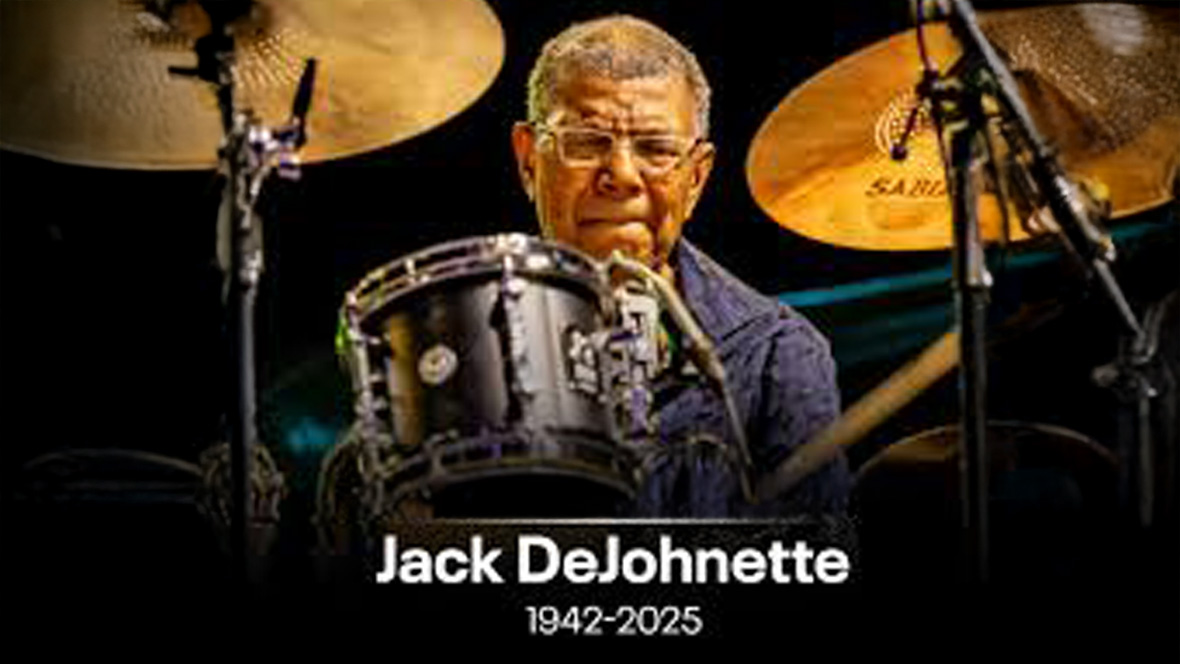
Jack DeJohnette was more than a drummer—he was a sound architect, a rhythmic storyteller, and one of jazz’s most imaginative voices. His passing marks the end of an era that stretched across six decades of exploration and reinvention. From his early days on Chicago’s South Side to his boundary-breaking work with legends like Miles Davis, Keith Jarrett, and Herbie Hancock, DeJohnette reshaped what jazz percussion could be: fluid, melodic, spiritual, and endlessly evolving.
Born in 1942, DeJohnette came up in an era when the lines between jazz, R&B, and blues were porous, and that eclecticism remained the pulse of his artistry. He began as a pianist, and that sense of harmonic depth would later inform his drumming—a rare blend of rhythmic power and compositional sensitivity. Even when he sat behind the kit, his touch carried the lyricism of a pianist’s phrasing, sculpting rhythm like melody.
DeJohnette’s rise in the 1960s coincided with one of jazz’s most seismic shifts: the move toward fusion and freer forms. After making his name in Chicago’s experimental circles, he joined Charles Lloyd’s groundbreaking quartet with Keith Jarrett and Ron McClure, a group that brought jazz to rock venues and new, younger audiences. His dynamic, open style propelled the band’s improvisations, foreshadowing the kind of rhythmic elasticity that would later define his sound.
When Miles Davis called in 1969, DeJohnette was ready for the challenge. The resulting work on Bitches Brew didn’t just alter jazz—it redefined modern music. DeJohnette’s drumming on that record was volcanic yet controlled, shifting seamlessly between groove and abstraction. His time with Miles placed him at the epicenter of jazz’s electric revolution, but rather than being consumed by it, he absorbed it, expanded it, and made it his own.
Throughout the 1970s, DeJohnette became one of the most sought-after drummers in the world. He recorded as a leader, forming Special Edition, a rotating collective of musicians that fused avant-garde energy with soulful groove. His records weren’t just showcases for his technical brilliance—they were sonic landscapes, drawing from world music, funk, and ambient textures. DeJohnette proved that jazz could remain exploratory while still deeply rooted in groove and spirit.
The most enduring chapter of his career, however, may have been his long partnership with Keith Jarrett and Gary Peacock in the Standards Trio. For over three decades, the trio became one of the most revered ensembles in modern jazz, known for transforming the Great American Songbook into a living, breathing dialogue. DeJohnette’s contribution was not mere accompaniment; he was a co-narrator, shaping the trio’s emotional trajectory with grace, wit, and intuition.
What made DeJohnette singular was his ability to listen—to truly listen. Whether behind Jarrett’s rhapsodic improvisations or John Coltrane Jr.’s searching saxophone lines, he didn’t just keep time; he expanded it. His cymbals shimmered like breath, his snare spoke in sentences, and his bass drum whispered as much as it thundered. He understood that rhythm wasn’t just about counting—it was about communicating.
DeJohnette’s music always carried a sense of peace, even when it roared. A longtime student of spirituality and meditation, he believed that sound had healing power. This ethos guided his late-career recordings, such as In Movement, a transcendent collaboration with Ravi Coltrane and Matthew Garrison, sons of his former bandmates from Coltrane’s and Miles’s classic ensembles. The project symbolized continuity—generations meeting through rhythm.
His influence extends far beyond jazz. Hip-hop producers, electronic artists, and experimental composers all cite DeJohnette as an inspiration. His use of space, polyrhythm, and texture prefigured the genre-blurring sensibilities of modern improvisers. Yet through it all, he never abandoned jazz’s core values: freedom, dialogue, and swing.
Those who played with him often remarked on his quiet generosity. DeJohnette was a mentor without ego, encouraging younger drummers to find their own voice rather than replicate his. His approach to music—curious, fearless, and humble—became a philosophy of life. He saw rhythm as a universal language, one that could unite cultures and dissolve barriers.
In his final years, DeJohnette remained active, performing and recording with the same fire that had defined his early work. Even as his body aged, his playing retained its supple elegance, as if time itself bent to his rhythm. When he sat behind the drums, he didn’t just play music—he summoned it, from the air, from memory, from spirit.
Jack DeJohnette’s passing leaves a silence that feels cosmic, but within that silence echoes a profound truth: rhythm never dies. It moves through generations, through every musician he inspired, through every note he left behind. Like Elvin before him and Tony beside him, DeJohnette’s voice on the drums was one of infinite conversation—a reminder that in jazz, and in life, the beat goes on.