Stones, Stories, and Sacred Suppers
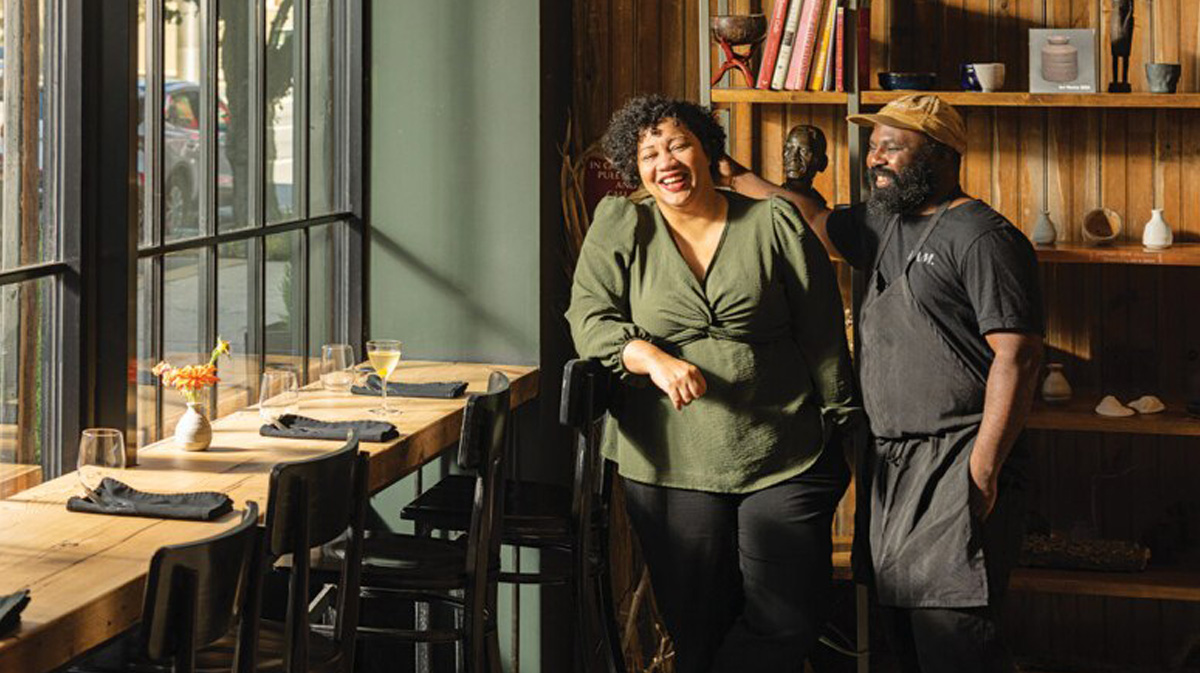
The first thing that arrives at the table at Honeysuckle is not a plate at all, but a stone. It has the ordinary look of something pulled from a field—flat, brown, unremarkable until you realize it has been chosen carefully from a farm that partners with the restaurant. Resting on this rock is a bite-sized cube of dark, rough bread, a generous smear of triple-cream Brie, and a tangle of blood orange threads that shine with sugar. It is barely enough food to quiet a growling stomach, but that is not what it is there to do. This first offering announces that, at Honeysuckle, nourishment is as much about imagination and history as it is about fullness.
That little cube of acorn bread does something uncanny when you put it in your mouth. The bread is dense and earthy, the cheese lush and decadent, the marmalade bright with Jamaican citrus, and, together, they create a rush of flavor that feels far weightier than the portion size suggests. For some diners, it may feel like a magic trick—how can something so small knock the wind out of you? But the real magic comes when a server leans in and begins to tell the story behind it, turning that single bite into a portal.
The inspiration, the server explains, comes from Octavia Butler’s “Parable of the Sower,” in which the main character’s father bakes acorn bread and the protagonist scavenges fruits and nuts to survive. By translating that imagined bread into something tangible, chefs Omar Tate and Cybille St. Aude-Tate connect speculative fiction, Black futurism, and the physical act of eating. The marmalade has its own origin story, the Brie its own method and care, and suddenly the stone in front of you is not just a serving vessel but a stage on which memory, literature, and technique meet. You do not simply learn what you are eating; you understand why it exists.
This is the key to Honeysuckle: it is not just a dining room, but a narrative being told in courses, asides, and punchlines. The restaurant runs on a prix-fixe structure, but the choices inside that structure are framed as “which story do you want to hear tonight?” Amuse-bouches, snacks, main plates, and dessert are arranged like chapters, each one in conversation with Black foodways, personal memory, or popular culture. What might be, elsewhere, simple menu descriptions become prompts for reflection and conversation.
Consider the fried hen-of-the-woods mushroom that appears before dinner. At first glance, it looks like a playful snack, crisp and golden, yet it arrives tucked into a miniature bright-red box that unmistakably recalls fast-food packaging. On the side is a dipping sauce whose flavor evokes Chick-fil-A more than classical French cooking. Honeysuckle’s kitchen frames this as their own version of a McNugget, a sly critique of fast-food culture disguised as a familiar indulgence. With that one move, the restaurant asks you to think about what you grew up eating, what was accessible, and what it means to recreate those flavors in a space devoted to celebration and care.
The vegetable course speaks a different dialect of the same language. Here, there is no heaping pile of produce to prove abundance. Instead, the board holds a series of small, carefully chosen bites: salted pickles, a raw fig, a knob of raw sorghum that releases a gentle sweetness as you chew, a shot of melon liqueur. It is “bounty restrained,” a curated expression of harvest that asks you to notice each texture and flavor individually before assembling them in your mind as a whole. It is generosity measured not in volume, but in intention.
Then there is the “McDonald’s Money burger,” a dish that wears its joke loudly and still manages to be luxurious. The name recalls those childhood evenings when a family had just enough extra cash to make a trip to McDonald’s feel like a party. At Honeysuckle, that memory is reimagined as a burger loaded with black truffle and crowned with caviar, a tongue-in-cheek tribute to both the thrill of fast food and the excess of fine dining. It is satire you can eat, but also a genuine tribute to the joy of small celebrations.
Honeysuckle builds on the foundation of Honeysuckle Provisions, the couple’s earlier project in University City, which was designed to uplift Black food traditions. In this new space, that mission is sharpened and amplified. The menu celebrates African diaspora cuisines with the precision and theatricality of high-end tasting menus, placing Black food at the literal center of the plate. Here, honoring ancestors is not an abstract slogan; it happens through ingredients, techniques, and stories that are unapologetically rooted in Black culinary history.
Some of the dishes deliver this homage through meticulous composition. A salad russe reappears as an almost architectural puzzle of tiny cubes: pickled beets, heirloom potatoes, and other elements arranged in small, deliberate piles. Limes are dusted with powdered Ghanaian shito, a chili condiment that, when transformed into a fine seasoning, gets playfully nicknamed “Cheeto dust.” A roasted half-chicken is rubbed with Haitian epis, the fragrant herb paste that perfumes so many Caribbean kitchens, and comes alongside finely chopped grilled collards and a charred leek aioli that softens the greens’ harsh edges. These plates do not simply nod to global influences; they insist on the depth and complexity of Black culinary lineages.
Still, the restaurant understands that not every dish has to deliver a thesis. Some things are allowed to just be enjoyable, and Honeysuckle leans into that pleasure. The hush puppies, for instance, are golden and crisp, sitting in dots of Cajun holy trinity relish—onion, bell pepper, and celery—that later reappear as the flavors of a digestif soda. Thin slices of country ham curl over them like tiny hats, adding salt and richness. There may be meaning you can read into that composition, but it is enough that they are deeply, simply good.
The seafood Alfredo, meanwhile, feels like a flex. In a city where Alfredo sauce seems to appear on countless menus, Honeysuckle’s version stakes its claim with quiet confidence. The sauce is built on crème fraîche instead of heavy cream, enriched with local shellfish and wrapped around hand-cut tagliatelle. A proprietary “New Bay Spice” ties the dish together, nodding to familiar Old Bay flavors while asserting its own identity. It is as rich as a televangelist and as smooth as a late-night slow jam, proof that the kitchen can compete on sheer deliciousness even when it is not explicitly preaching.
By the end of the meal, what lingers is not just the memory of specific dishes but the feeling of having been drawn into a conversation. Honeysuckle invites diners to ask questions, to listen, to recognize themselves—or their absence—in the stories told through the food. It operates as both a restaurant and a kind of living text about Black experience, inheritance, and imagination. The four-star rating it receives, signaling “come from anywhere in America,” feels less like a mere accolade and more like an invitation.
In the end, the review’s plea is simple: go. Go without over-researching, go ready to be surprised, go willing to learn something you did not know you needed. Honeysuckle is doing something rare—using the familiar rituals of dinner to reframe whose stories are told at the table, and how lovingly they are served. In a city full of excellent restaurants, it stands apart not just because the food is remarkable, but because there is, truly, no one else who can tell this particular story quite the way Omar Tate and Cybille St. Aude-Tate do.
In summary, this essay reframes the original review’s core ideas—Honeysuckle as narrative-rich Black fine dining, where every course is a story—into fresh language and structure while staying faithful to the source’s facts.