Baltimore’s Remarkable Crime Turnaround
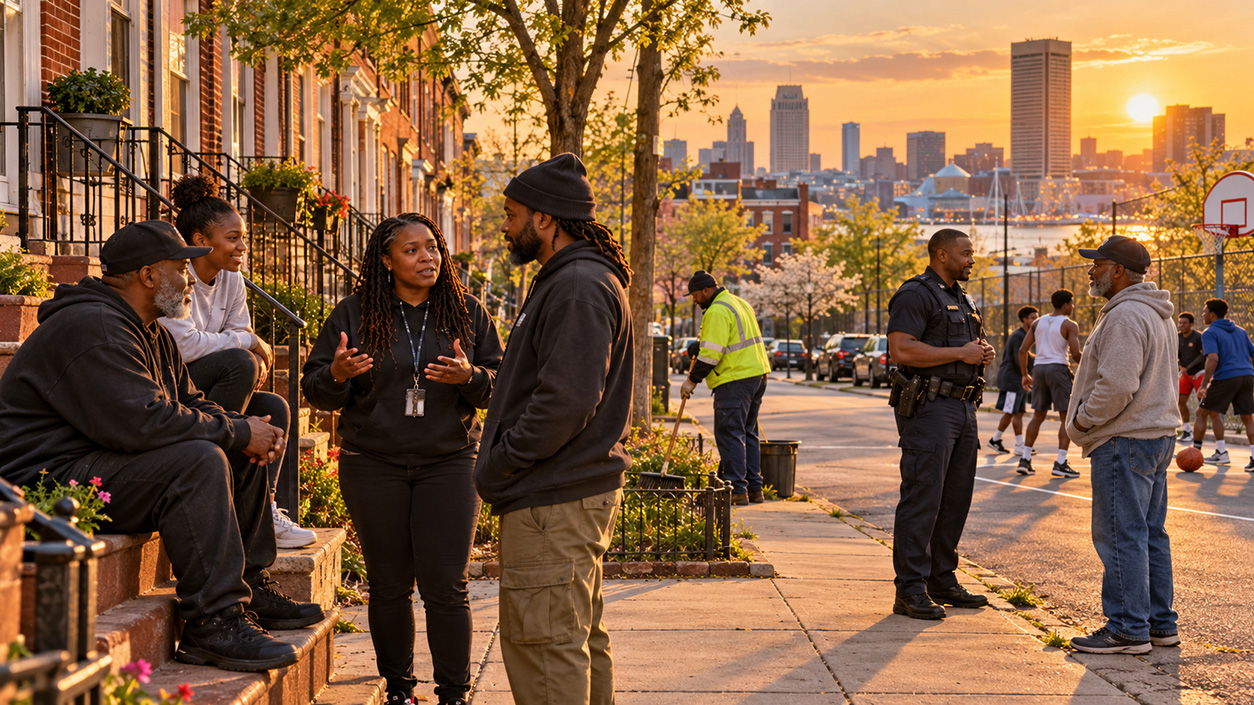
Baltimore has experienced a dramatic decline in violent crime in recent years, marking a significant change for a city that has struggled with gun violence and homicides for decades. The decline has been particularly notable in homicides and nonfatal shootings. In 2025, Baltimore recorded 133 homicides, down from 194 in 2024, while nonfatal shootings fell from 412 to 311. The first half of 2026 continued the trend, with homicides down another 23 percent compared with the same period in 2025. These numbers represent one of the most significant periods of sustained crime reduction Baltimore has experienced in decades.
One important part of Baltimore’s approach has been the Group Violence Reduction Strategy (GVRS). Rather than treating every crime as an isolated incident, GVRS focuses on the relatively small groups and individuals who are responsible for a disproportionate amount of serious violence. Police, prosecutors and community organizations work together to identify people at high risk of involvement in violence, communicate directly with them, and offer both consequences and opportunities to change their circumstances.
Another important component has been the expansion of community violence intervention. Baltimore’s strategy has increasingly recognized that police cannot solve the problem of violence by themselves. Organizations such as Safe Streets Baltimore work directly in neighborhoods, attempting to mediate conflicts before they escalate into shootings or killings. Violence interrupters and community workers can sometimes reach people in situations where traditional law enforcement has difficulty establishing trust.
Baltimore has also invested in neighborhood stabilization and environmental improvements. City agencies have conducted coordinated operations addressing abandoned buildings, illegal dumping, vacant properties, abandoned vehicles and poor lighting. These may seem unrelated to violent crime, but improving the physical condition of neighborhoods can make public spaces safer and increase residents’ sense of ownership and security.
The police department has simultaneously increased its emphasis on data-driven policing. Crime patterns, geographic hotspots and emerging trends are examined to determine where officers and investigative resources should be concentrated. Baltimore has also reorganized investigative operations and placed greater emphasis on solving violent crimes. Higher clearance rates mean investigators are identifying and prosecuting more people responsible for shootings and homicides.
Gun enforcement has also been central to the strategy. Baltimore police have seized thousands of firearms, including ghost guns, while investigators have concentrated resources on people and groups connected to shootings. The city has also pursued legal action involving gun manufacturers and dealers. The broader strategy recognizes that reducing access to illegally possessed firearms can be an important part of reducing the number of violent encounters that become deadly.
Another major element has been the effort to rebuild the relationship between police and residents. Baltimore’s police department has been operating under a federal consent decree requiring changes in areas such as training, supervision, use of force, accountability and community engagement. The idea is that effective policing requires both enforcement and public trust. Greater accountability can make residents more willing to cooperate with investigators and provide information about violent crimes.
Baltimore has also expanded programs aimed at young people and people at elevated risk of violence. Youth programs, mentoring, employment opportunities and intensive case management are intended to give young people alternatives to street involvement. Programs connected with GVRS have provided services such as housing assistance, stipends and individualized support. The philosophy is that preventing violence sometimes requires addressing the circumstances that make continued involvement in violence more likely.
The city’s approach is therefore different from relying exclusively on either aggressive policing or social programs. Baltimore has increasingly combined targeted law enforcement, community intervention, youth programs, neighborhood improvements, gun enforcement and data analysis. That combination is important because violent crime has multiple causes, and no single policy can reasonably explain every change in crime levels.
It is also important to recognize that Baltimore’s progress does not mean the problem has disappeared. Even after the substantial reductions, residents continue to experience shootings, robberies and other crimes, and every homicide represents a serious loss for a family and community. Crime statistics can also change as reporting practices and classifications are updated. Baltimore recently changed how historical homicides are assigned to calendar years to comply with federal reporting standards, so comparisons across years need to be made carefully.
Still, Baltimore’s recent experience provides an important example of what can happen when a city treats violence as a public-safety and community problem simultaneously. The dramatic reductions in homicide and shootings have occurred alongside targeted policing, community violence intervention, neighborhood stabilization and services for people at high risk. The continuing challenge for Baltimore will be determining which elements of this approach can be sustained over many years—and whether the reductions can continue while the city builds greater trust, opportunity and safety in its neighborhoods.