Basquiat Painted Against The Silence
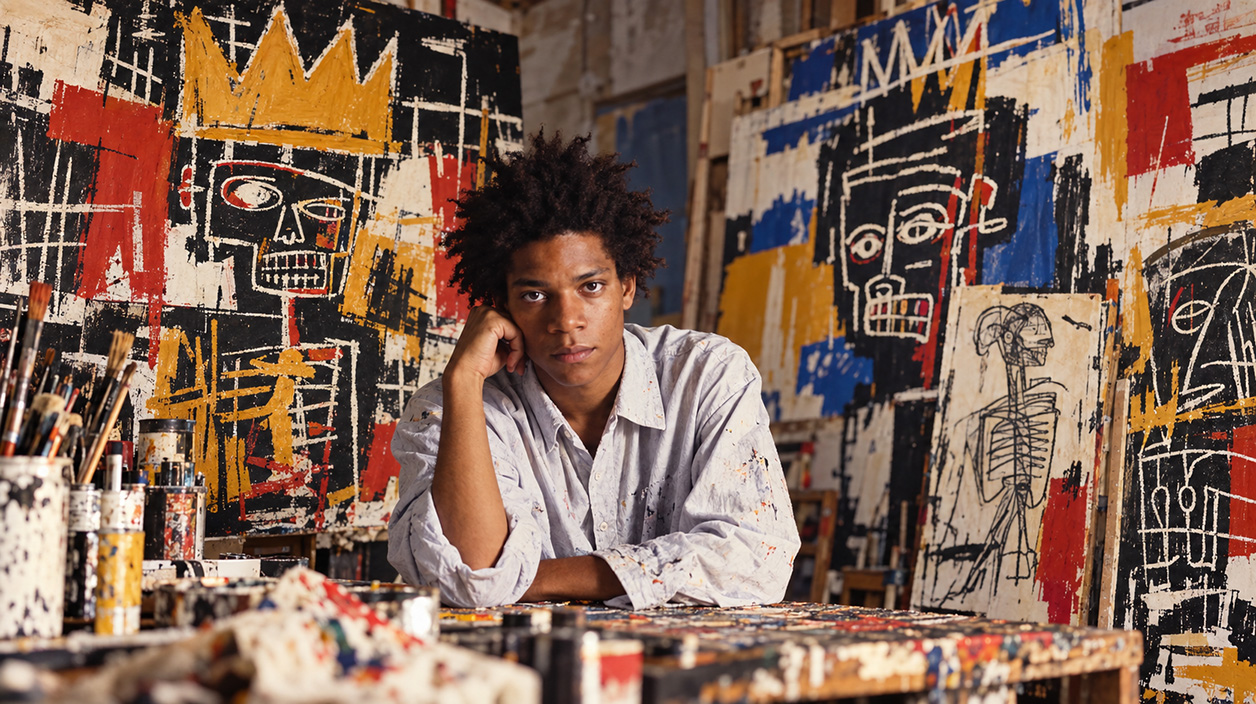
Jean-Michel Basquiat’s paintings seem to speak all at once. Words interrupt figures. Crowns hover over heads. Color surges across surfaces marked by lists, symbols, and hurried lines. Yet the energy is deliberate. Basquiat made art that asked who gets remembered, who gets ignored, and who has the power to tell history.
Born in Brooklyn in 1960 to a Haitian father and Puerto Rican mother, Basquiat grew up amid several languages and cultural traditions. As a young artist in Lower Manhattan, he absorbed the city’s music, street life, and restless creative scene. New York gave him subjects to paint and a public space in which to make himself heard.
In the late 1970s, Basquiat and Al Diaz placed enigmatic statements around the city under the name SAMO. These messages mixed humor, criticism, and poetry. They made passersby pause over a few words and consider what those words might mean. Before Basquiat became known for paintings in galleries, he had learned how to command attention in the street.
His paintings began drawing wider notice after the 1980 Times Square Show. Basquiat soon emerged as a striking voice in an art world that had rarely made room for young Black artists on their own terms. Success brought opportunity, but it also brought scrutiny. He recognized the racism in a culture that celebrated his work while sometimes reducing him to a convenient story about fame.
Basquiat answered with paintings dense with thought. A single canvas might bring together a name, an anatomical drawing, a historical reference, and a phrase crossed out but still visible. The marks can feel spontaneous, yet they reward slow looking. Each return to the work reveals another connection or question.
The crown became one of his most recognizable images. Above a figure’s head, it could draw a viewer’s eye toward someone whom history or popular culture had overlooked. Basquiat repeatedly brought Black art, music, and experience into his work, insisting that these lives and contributions belonged at the center of the picture.
Music shaped the movement of his paintings. Their repeated words, shifting symbols, and bursts of color can suggest the improvisation of jazz. Basquiat painted musicians, but he also seemed to think like one: returning to a theme, changing its rhythm, and leaving space for an unexpected note.
His work also confronted violence and the ways power is recorded in history. Lists and diagrams can resemble attempts to classify the world, while his figures push against being contained by them. Basquiat did not offer simple answers. He placed conflicting ideas together and trusted viewers to feel the tension between them.
Basquiat died in 1988 at age 27. His short life has often threatened to overshadow what he accomplished during it. He left approximately a thousand paintings and two thousand drawings—an extraordinary body of work whose questions about race, recognition, and belonging remain urgent.
To stand before a Basquiat painting is to encounter an artist who wanted to be seen and wanted us to look more closely at others. The crowns, words, and figures still demand attention. Decades after his death, his work refuses to settle into silence.