Artist King Saladeen

King Saladeen is a self-taught contemporary artist from West Philadelphia whose career has rapidly evolved from local creativity to global visibility. He uses bold colors, playful symbols, and a visual lexicon that draws on hip-hop, youth culture, sports, and community pride.
Raised in a neighborhood where artistic outlets were scarce, Saladeen’s early years included drawing on whatever surface he could find and playing basketball as a way to navigate his surroundings. He later discovered that his love for art and design could become his career—not just his hobby.
In 2011, Saladeen launched the Saladeen Art Group, a vehicle for his artistic ambitions and his commitment to motivational messaging. By 2014 he rebranded this into Create Motivate Inspire (CMI), which functions not only as a personal motto but a mission statement for the work he does, both as artist and community builder.
Much of his signature work features a character known as “JP the Money Bear,” a kind of mascot embodying resilience, aspiration, and remembrance. The bear is a tribute to his friend JP Thompson, who encouraged Saladeen to pursue the arts and passed away in 2013. Saladeen has said that the bear is “not a toy; it’s a reminder to dream big, love what you do, and surround yourself with people who see you, encourage you, and motivate you.”
Saladeen’s installations and murals have brought his work into public space at a scale rarely seen by someone who did not follow the traditional art-school trajectory. For example, his mural Brotherly Love (2024) in Philadelphia’s Northern Liberties neighborhood depicts two bears in front of the skyline and stands as both a tribute to his friend and a message of community bonding.
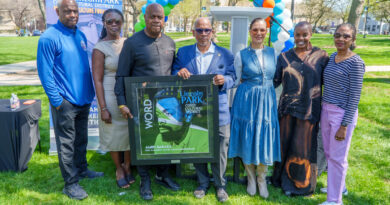
In 2025, Saladeen was honored with the Arts & Crafts Visionary Artist Award by the Mural Arts Philadelphia at their Wall Ball fundraising event—an acknowledgement of the breadth of his community impact and his artistic evolution.
Beyond murals, Saladeen’s cross-industry collaborations highlight the hybrid nature of his practice. He has worked with sports brands, created art for trading cards (including work for the Topps company), and designed luxury objects, all while blending fine art with reference points from street culture. The result is a practice that does not sit comfortably in one category—it moves across design, branding, and public art.
What sets Saladeen apart is the combination of aesthetic exuberance and motivational content. His work is unapologetically colorful and expressive, yet it carries a message: art is accessible, art is for people like us, art can transform space and lives. For youth in Philadelphia (and beyond) his story offers a blueprint: from sketching on walls to making walls themselves into works of art.
Looking ahead, Saladeen continues to build not just his brand but his legacy. His studio practice, public art engagements, and community initiatives suggest an artist who understands both the power of image and the responsibilities of influence. He is bridging the gap between commercial success and neighborhood uplift, reminding us that “dream big” isn’t just a slogan—it’s a way of life.
In sum, King Saladeen stands as a vivid example of how contemporary art can be rooted in place, culture, and community—and still reach global audiences and platforms. His journey from West Philadelphia to public murals, brand collaborations, and international art circuits shows how creativity, ambition, and authenticity can converge in the figure of one artist committed to both excellence and uplift.