Arturo Schomburg Preserved Black History
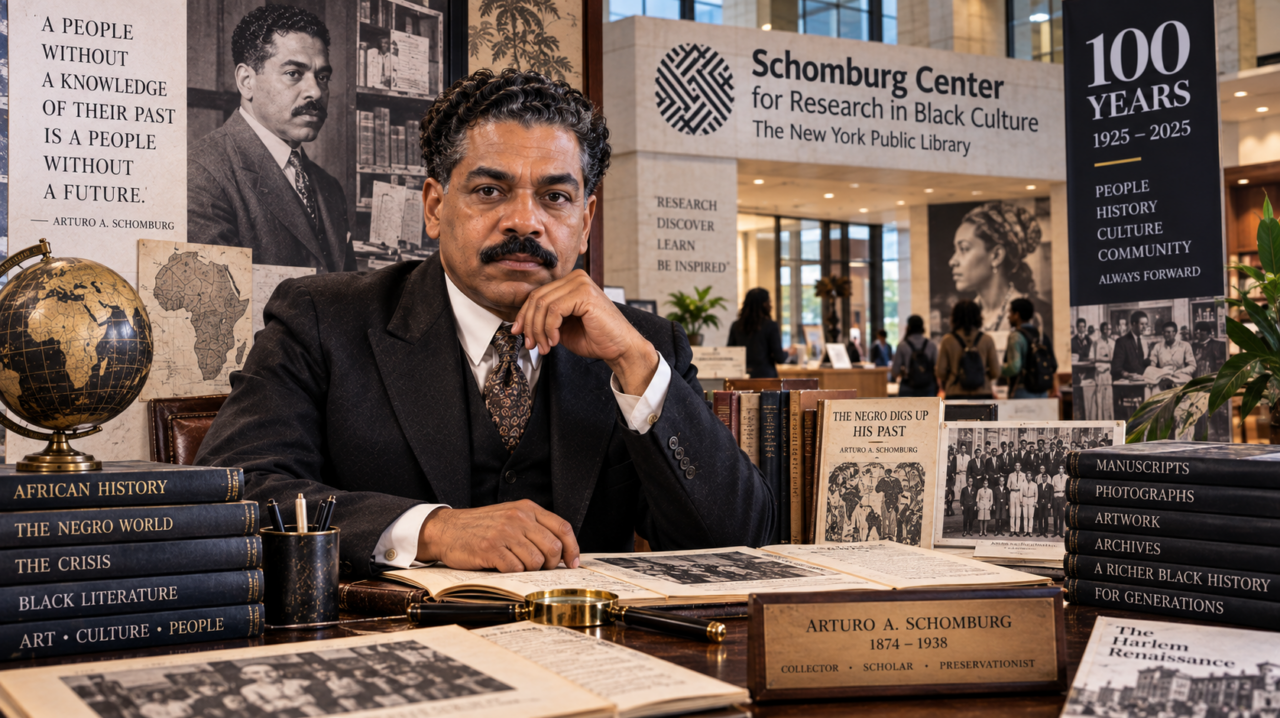
Arturo Alfonso Schomburg was one of the most important collectors and preservationists of Black history in the United States. Born in Puerto Rico in 1874, Schomburg devoted much of his life to documenting the achievements, experiences, literature, art, and history of people of African descent. His life’s work eventually became the foundation of the institution in Harlem that bears his name: the Schomburg Center for Research in Black Culture.
Schomburg’s interest in Black history developed at an early age. According to the New York Public Library, as a child he encountered the idea that Black people had little or no history worth studying. Rather than accepting that notion, Schomburg spent his life searching for evidence that demonstrated the depth and breadth of Black achievement. His collecting became a personal mission to uncover and preserve stories that had been overlooked or forgotten.
Schomburg came to New York City in 1891 when he was 17 years old. He became involved in Puerto Rican and Cuban independence movements and later became increasingly involved in organizations dedicated to documenting Black history and culture. His experiences as a Puerto Rican and as a member of the African diaspora helped shape his understanding that Black history extended far beyond the boundaries of the United States.
During the early twentieth century, Schomburg began assembling an extraordinary collection of books, manuscripts, pamphlets, artwork, prints, and other historical materials. In 1911, he and historian John Edward Bruce helped establish the Negro Society for Historical Research. They collected materials wherever they could find them, preserving documents that might otherwise have disappeared.
Schomburg’s work became particularly important during the Harlem Renaissance. He lived in an era when Harlem was becoming a major center of Black intellectual, artistic, and cultural life. Schomburg wrote about Black history and the African diaspora for publications including The Crisis, Opportunity, Negro World, and the New York Amsterdam News. His 1925 essay, “The Negro Digs Up His Past,” became an important statement about the necessity of recovering Black history.
His relationship with the New York Public Library’s 135th Street Branch was equally significant. In 1924, librarian Ernestine Rose invited Schomburg to participate in discussions about establishing a department devoted to Negro literature and art. The following year, the Division of Negro Literature, History and Prints opened at the 135th Street Library, creating an institutional home for materials documenting the African diaspora.
In 1926, the New York Public Library acquired Schomburg’s personal collection with the assistance of a $10,000 grant from the Carnegie Corporation. His collection included thousands of volumes, pamphlets, prints, manuscripts, and other materials. The acquisition transformed the 135th Street Library’s ability to serve researchers interested in Black history and helped establish the foundation for what would eventually become the Schomburg Center.
Schomburg continued his work as a curator and scholar. In 1932, the New York Public Library hired him as curator of the Division of Negro Literature and Art. He remained in that position until his death in 1938. In 1940, the collection was renamed the Schomburg Collection of Negro Literature, History and Prints in his honor. In 1972, the institution became the Schomburg Center for Research in Black Culture.
Today, the Schomburg Center stands at 515 Malcolm X Boulevard in Harlem and has grown enormously beyond the collection Schomburg originally assembled. The New York Public Library says the Center now holds more than 11 million items documenting African American, African Diasporic, and African experiences. Its collections include books, photographs, manuscripts, artwork, artifacts, recorded sound, and moving images.
The lasting importance of Arturo Schomburg is that he understood that preserving history is an essential part of understanding identity. He did not simply collect old books and documents; he searched for evidence of a global Black experience that deserved to be remembered and studied. More than a century later, his name remains attached to one of Harlem’s most important cultural institutions. The Schomburg Center’s existence demonstrates how one person’s determination to preserve history can create a resource that educates generations long after that person is gone.
The Schomburg Center celebrated its 100th anniversary in 2025, making Schomburg’s story especially timely.